AI could create a faster COVID-19 test
Siobhan Treacy | November 12, 2020Researchers from Osaka University created a new system that can identify viruses of common respiratory pathogens with a little help from machine learning.
The new system uses sensitive nanopores and a machine learning algorithm. The algorithm was trained on changes in current as it moves across the silicon nanopores of their device. This new method could lead to fast and accurate screening for viruses and diseases, like COVID-19.
The silicon nitride layer is 50 nm thick and suspended in a silicon wafer with tiny nanoparticles that measure 300 nm in diameter. It is sensitive enough to detect viruses, like COVID-19 or influenza.
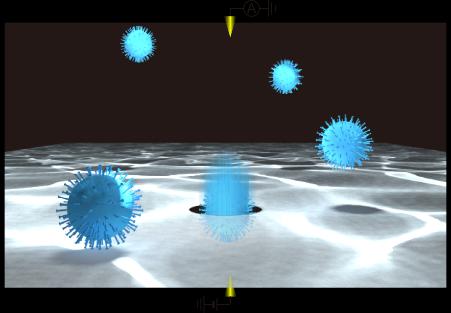 Single virus particle detections using a solid-state nanopore. Source: Osaka University
The device operates using a voltage applied to the solution on either side of the wafer ions. The voltage travels through nanopores using a process called electrophoresis. Ion motion is monitored by the generated current. When a viral particle enters the nanopore, it blocks some of the ions from passing through, leading to a transient dip in the current.
The dips reflect the physical properties of the particles, including volume, surface change and shape, which are used to identify a virus. Natural variation in physical properties of virus particles that previously hindered the implementation of the approach.
The machine learning algorithm was used to build a classification algorithm trained with signals from the known viruses to identify new samples. The computer can find the differences in electrical current waveforms that cannot be seen by the human eye, creating highly accurate virus classification.
Researchers tested the system with COVID-19, respiratory syncytial virus adenovirus, influenza A and influenza B. The team believes that coronaviruses are suited for this technique because of their spiky outer protiens. The new method is much faster than current rapid testing methods and does not require reagents, leading to improved diagnostic tests for viral particles that cause infectious diseases.
A paper on the new method was published in ACS Sensors.