Worms to consume oil waste
Marie Donlon | November 10, 2020Scientists from the Bionanotechnology Lab of Kazan Federal University are attempting to imbue microscopic roundworms with oil eating properties.
The team of scientists are using roundworms, otherwise known as nematodes, as a vehicle for oil-consuming marine bacteria that can break down and consume oil products and transform them into fatty acids.
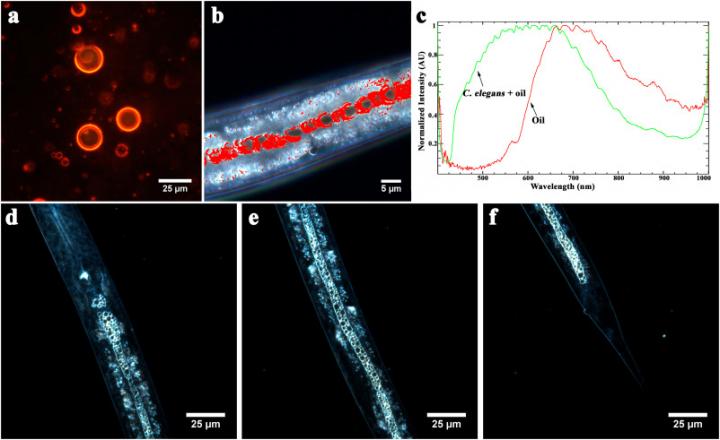 Dark-field image of crude oil droplets (a) and hyperspectral dark-field image of nematode intestine merged with hyperspectral crude oil mapping (b), obtained using reflected light spectra of intact crude oil and oil in intestine of C. elegans nematode (c). Dark-field microscopy images demonstrating the localisation of crude oil in the Dauer larvae nematodes' intestines after incubation for 42 h from L1 larvae stage: inside the foregut (d); in the midgut (e) and inside the hindgut (f). Source: Kazan Federal University
"We took Caenorhabditis elegans nematodes and fed them Alcanivorax borkumensis bacteria. Nematodes have bacteria as a usual part of their diet, so there were no negative consequences for them. Furthermore, undigested bacteria changed the gut microflora of worms, which led to enhanced digestion of oil, and then left their bodies through natural ways. As another takeaway from the experiment, we found out that worms can themselves eat oil products if they are not fed anything else," explained study co-author and chief research associate Rawil Fakhrullin.
In the worm’s digestive system, oil is reduced to smaller 5 mm to 6 mm particles and the bacteria further reduces them.
The research appears in the journal Science of the Total Environment.