Aging infrastructure may benefit from sustainable solution
Amy Born | October 05, 2020Safety as well as the costs associated with ongoing maintenance are major concerns surrounding infrastructure such as bridges. In places like New Zealand, where much of that infrastructure is close to the coast, corrosion impacts both of those concerns. As such, new research from the University of Canterbury (UC) is looking at the impact deterioration has on structural performance, particularly for reinforced concrete.
Ph.D. candidate Cain Stratford is studying bars made from glass fiber-reinforced polymer (GFRP) as a replacement for steel reinforcement in structures, specifically bridge columns located in harsh environments. GFRP is corrosion-free, has a higher tensile strength than steel and weighs one-quarter as much. While investigating whether GFRP bars achieve significantly better design life for bridges while also providing enough seismic performance, Stratford found that their lightweight made the construction of the columns easier.
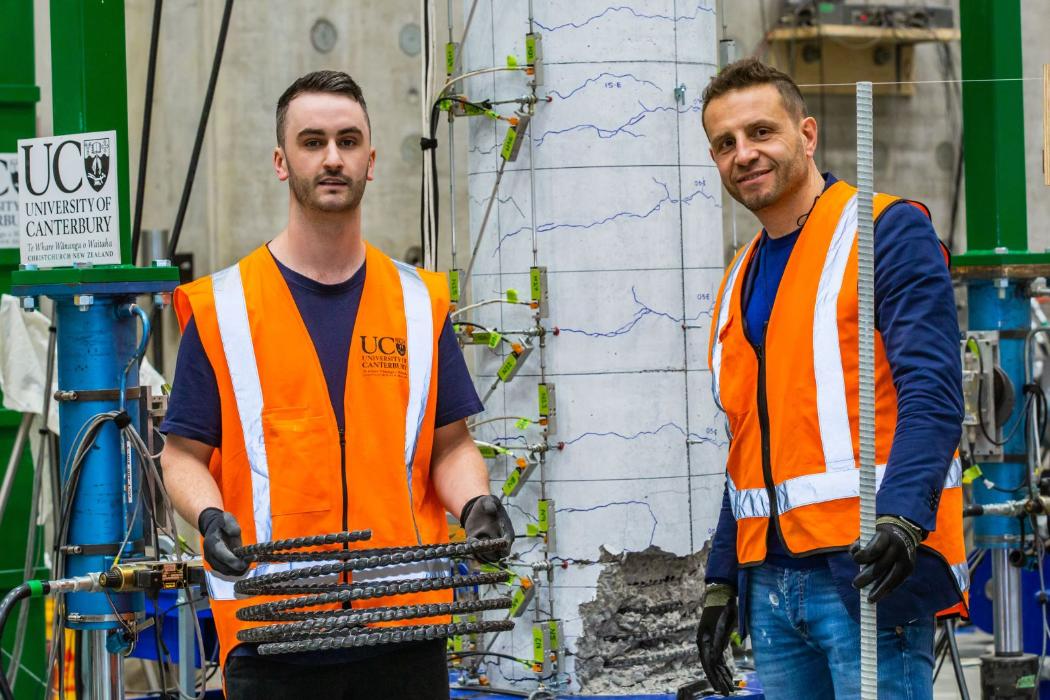 New research at UC led by structural engineering professor Alessandro Palermo (right) has highlighted the impact deterioration can have on the performance of structures. Ph.D. student Cain Stratford (left) is investigating how GFRP bars may be used in reinforced-concrete bridge columns. Source: University of Canterbury
“The experiment has been designed to simulate the loading that a bridge pier may be expected to withstand during a seismic event. Initial results from our tests have shown that a combination of GFRP bars with conventional steel can be an optimum choice to guarantee both excellent seismic performance and an increase in the usable life of the structure,” Stratford said.
Infrastructure should be sustainable in more ways than the construction carbon footprint, said structural engineering professor Alessandro Palermo, who led the research team. “In the next 30 to 50 years, we will have more people, more bridges and probably less money to maintain our infrastructure. We need to look forward and opt for more durable materials. This will significantly reduce maintenance costs and increase structural life-cycles.”
According to a University of Miami study published last year, GFRP bars taken from bridges with up to 20 years of service life maintained more than 97% of their original strength with no corrosion.
Callaghan Innovation sponsored the Ph.D. program with the hope of increasing the use of GFRP rebars in New Zealand.