
LMU chemists find bacterial enzyme that can safely extract rare earth elements
Marie Donlon | September 18, 2020Chemists at Ludwig Maximilian University of Munich (LMU) have discovered that a co-factor in a bacterial enzyme can extract rare earth elements (REEs) — which are vital ingredients in electronic devices — from mixtures.
The team of LMU chemists determined that an enzyme co-factor dubbed pyrroloquinoline quinone (PQQ), which can be found in assorted bacteria species, can selectively bind to particular REEs, separating them from their mixtures.
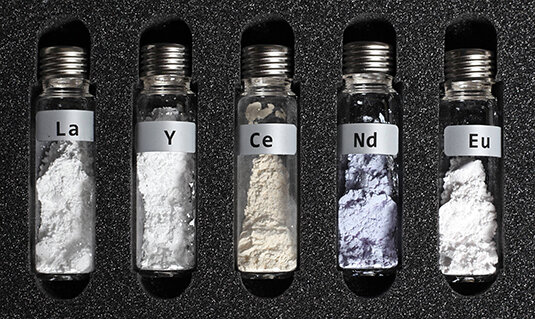 Rare earth elements from lanthanum (La) to europium (Eu). With increasing atomic weight, the ion radius sequentially decreases. Source: JOKER / Alexander Stein
REEs — which include scandium, yttrium, lanthanum and the 14 lanthanides that follow lanthanum on the Periodic Table — are commonly used in computers, smartphones and electric motors, typically in their magnets and batteries. Likewise, they can also function as chemical catalysts.
In nature, REEs form mixtures and, because they exhibit similar chemical properties, are difficult to distinguish and, consequently, separate from one another without impacting the environment or expending significant energy.
However, the LMU chemists selectively removed REEs via precipitation from aqueous solutions that included mixtures of the REEs’ salts without using hazardous organic solvents or other additives. By doing this, the team discovered that PQQ binds to lanthanides such as neodymium. This discovery, according to the LMU team, could have implications for the future of sustainable technologies
"One characteristic of the lanthanides is that the ionic radius progressively decreases across the row from lanthanum to lutetium, and these minuscule differences can be used to separate them," an LMU chemist explained.
The research appears in the journal Chemistry: A European Journal.


PQQ is an important component of mitochondrial chemistry in our cells. There is evidence suggesting that PQQ supplements may slow the effects of aging.