Polymer membrane removes steroid hormones from water
S. Himmelstein | September 11, 2020The presence of steroid hormones, even at the nanogram level, in potable water supplies can pose human health and environmental hazards. The European Union has proposed a 1 ng/L drinking water quality standard for estradiol, an estrogen with varied medical uses. As conventional wastewater treatment technologies cannot detect or remove these molecules at low concentrations, a more efficient elimination method was devised at Karlsruhe Institute of Technology (KIT), Germany.
Water is first filtered through a semipermeable membrane to capture larger pollutants and biological agents. A 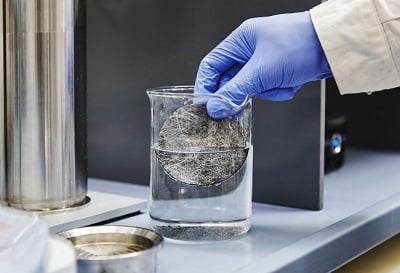 The filtration system removes hormones from drinking water. Source: Sandra Göttisheim, KITpolymer-based spherical activated carbon layer then binds the hormone compounds present. The use of smaller activated carbon particles allows reaching the target value of 1 ng/L in a 1 mm layer.
Adsorption kinetic enhancement by increasing the oxygen content on the carbon was demonstrated to improve the removal from 96% to 99%, using a 2 mm layer, for hydroxyl-containing pollutants such as estradiol. High removal and low pressure operation with no by-product formation make this a promising treatment approach.