
Solar energy based method could break down CO2 into useful products
Siobhan Treacy | September 04, 2020Researchers from Southern California Viterbi School of Engineering are working to create a technology that can break apart carbon dioxide (CO2) and convert it into useful materials using energy from the sun. The team says this is the first computational study of its kind to look at how sun energy can be used in CO2 conversion.
The team's goal is to turn harmful CO2 into fuels and consumer products. Typically this process requires a lot of energy, the team set out to use solar energy as a green energy replacement.
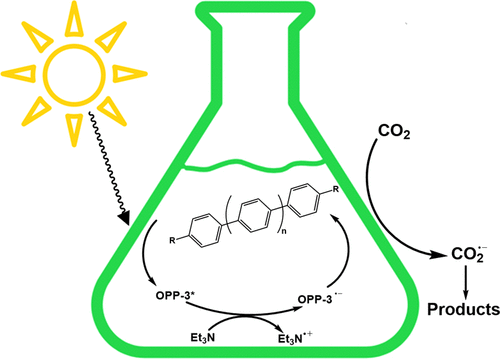 Source: Southern California Viterbi School of Engineering
Researchers demonstrated how UV light could be used to excite oligophenylene, an organic molecule. When exposed to UV, oligophenylene turns into a negatively charged anon and transfers electrons to the nearest molecule, like CO2. This makes CO2 reactive which can then be reduced and converted into plastics, drugs, furniture and more.
In traditional CO2 conversion, heat or electricity is used with a catalyst to speed up CO2 conversion into products. This is an energy-intensive process. But using sunlight to excite the catalyst molecule is an energy efficient and sustainable alternative. Another alternative is to use carbon-based organic catalysts for carrying out the light-assisted conversion.
The team used quantum chemistry solutions to understand how electrons move between catalyst and CO2 to identify viable catalysts. The team found that systematic modifications can be done to an oligophenylene catalyst. This adds groups of atoms that impart specific properties when bonded to molecules to speed up reactions.
The team has to address some challenges to this technology before it can be used commercially. The technology can harness radiation, but little of the radiation is in the visible region of the catalyst where light is shone in order to spark a reaction. The team is exploring catalyst design strategies that create high reaction rates and allow molecules to be excited by visible light. This method uses quantum chemistry and genetic algorithms.
A paper on this technology was published in the Journal of Physical Chemistry A.


I don't think plants and trees consider CO2 to be harmful.
The word ‘Harmful’ has contextual application .
My science teacher was telling about poisons .He asked us, ‘Is common salt poisonous?’
In one voice, we all answered in one voice ‘No’
He challenged us .’If you eat at a time a handful of common salt, which you all said, is not a poison, I guarantee, that you would die . Any takers ?’
From then, we knew about quantity as a necessity for labelling any thing as harmful.
We have a saying in Sanskrit ,
ATI SARVATRA VARJAYET, meaning, Excess Always Avoid .
In reply to #2
Well, let's put it into context then. How much is too much? 400 ppm?
Oops, we're already past that and the world is ending as we know it. Here is a link to a typical breathless exhortation:
https://www.commondr
The above article (not the link) has nothing to do with arguments about the ideal or desired concentrations of CO2 in our atmosphere.
My main point is that the word 'harmful' adds nothing to the content of this article.
In fact, it detracts from the quality of the rest of the piece because it instead of being a factual reporting on a process, it becomes editorialized. But some people just can't help themselves.
We're all adults here. Everyone understands the arguments on both sides of this issue and there is no need to beat one drum or the other. Agreement, is a completely different story. Each side has their own proof and facts and you won't change the beliefs of the believers or the deniers.
We need to continue to study the issue.
In reply to #3
You are right . The word ‘Harmful’ should not have been used .
I think you're quibbling unnecessarily; while it would be far more accurate to say "humanly harmful" for context. When dealing in an unspecified context with words like harmful, beneficial, good, bad, etc the Ockham's Razor default is and should be "humanly". It's not rocket science linguistics - we're human and we're speaking, therefore the first priority.
We can't assume that high CO2 is harmful. As already noted we have to deal with life and decay of plants, and especially ocean CO2 solubility and temperature. Fish breathe, too. It is PC in many circles to attack human activity as cause/cure of global warming and many fight restricting such activity (virus flouters of today). But restriction is necessary for a human to grow from baby to adult. The global warming is real and nonpolitical. Our thermometers are not hacked. We need responsible numbers to judge and act, not make-believers who want to make us believe.