Efficiency exceeds 100% for black silicon photodiode
S. Himmelstein | August 17, 2020Poor sensitivities and low efficiency undermine the performance of ultraviolet (UV) sensors deployed in diverse applications. Efforts by an international research team to boost photodetector performance have documented a 130% external quantum efficiency (EQE) value for black silicon induced-junction photodiodes.
The structure of this photodiode was observed to be particularly sensitive to UV radiation, which is absorbed in 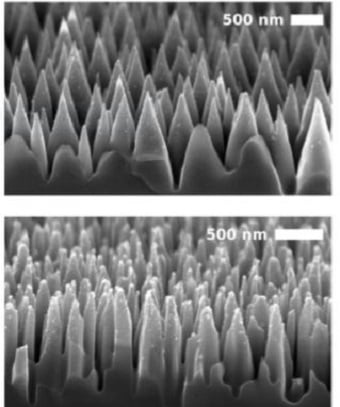 Scanning electron microscope image of black silicon nanotexture with cone-like (top) and columnar-like (bottom) morphology. Source: M. Garin et al.the first few nanometers of the device. The EQE values reach or exceed 130% without external amplification at wavelengths close to 200 nm. A 100% EQE indicates one incoming photon generates one electron to the external circuit; 130% efficiency means that one incoming photon generates approximately 1.3 electrons. The excellent performance reported in Physical Review Letters is based on effective utilization of multiple carrier generation by impact ionization taking place in the nanostructures.
The sensitivity of UV sensors can be improved by use of nanostructures and induced junction in lower band gap materials. In addition to photodiodes, the technology can also enhance solar cell performance if lower bandgap material could be used to efficiently capture the total energy of photons without suffering from thermal losses.
Researchers from Aalto University (Finland), Universitat Politècnica de Catalunya (Spain), ElFys (Finland) and Physikalisch-Technische Bundesanstalt (Germany) contributed to this development.