Beyond 100%: What this solar milestone really means
Cari Cooney | May 05, 2026 Solar Z-fold panels on top of a residence. Source: Wikimedia Commons CCO 1.0 WikiIdeas1
In an effort to combat climate change and lessen reliance on fossil fuels, solar electricity is crucial. Only a tiny portion of the enormous amount of energy that the Sun sends to Earth every second is captured by contemporary solar cells. This restriction results from an established "physical ceiling" that has proved tricky to get past.
Researchers from Kyushu University in Japan and partners from Johannes Gutenberg University (JGU) Mainz in Germany created a new method to overcome this obstacle in a study that was published in the Journal of the American Chemical Society on March 25. They captured excess energy produced by singlet fission (SF), which is sometimes referred to as a "dream technology" for enhancing light conversion, using a molybdenum-based metal complex called a "spin-flip" emitter.
By using this method, the team was able to obtain energy conversion efficiency of about 130%, which is higher than the conventional 100% limit and indicates the need for more sophisticated solar systems.
Why we lose energy
When photons from sunshine strike a semiconductor and transmit energy to electrons, causing them to move and form an electric current, solar cells generate electricity. Energy is transferred from one particle to another in this process, which is comparable to a relay.
But not every photon has the same utility. While high-energy photons, like blue light, waste their excess energy as heat, low-energy infrared photons lack the ability to activate electrons. As a result, only roughly one-third of the inbound sunlight can be used by solar cells. Known as the Shockley-Queisser limit, this restriction has continued to be a significant obstacle.
Multiplying energy with singlet fission
"We have two main strategies to break through this limit," said Yoichi Sasaki, Associate Professor at Kyushu University's Faculty of Engineering. "One is to convert lower-energy infrared photons into higher energy visible photons. The other, what we explore here, is to use SF to generate two excitons from a single exciton photon."
After excitation, each photon normally only generates one spin-singlet exciton. This single exciton can divide into two lower-energy spin-triplet excitons using SF, potentially doubling the available energy. While some materials, like tetracene, can facilitate this process, it has been challenging to effectively capture these 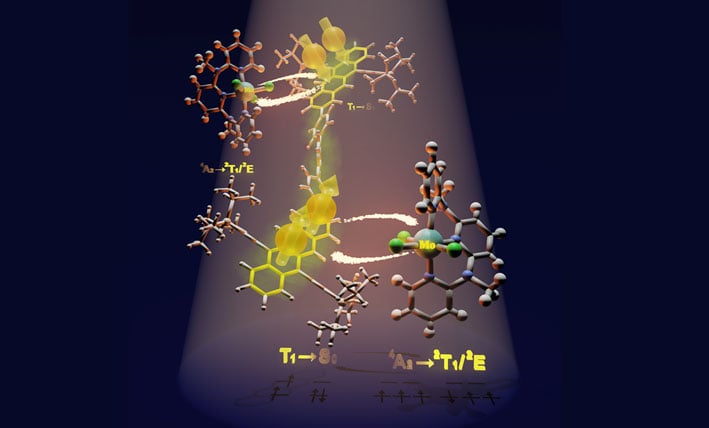 Researchers successfully capture singlet-fission–amplified excitons with a molybdenum-based emitter, achieving 130% quantum yield and opening a path beyond solar cell efficiency limits. Source: Kyushu University excitons.
"The energy can be easily 'stolen' by a mechanism called Förster resonance energy transfer (FRET) before multiplication occurs," Sasaki explained. "We therefore needed an energy acceptor that selectively captures the multiplied triplet excitons after fission."
The researchers used metal complexes, which can be accurately developed, to solve this problem. A "spin-flip" emitter based on molybdenum was found to be a successful remedy. In this approach, an electron can absorb the triplet energy produced by SF by changing its spin when it absorbs or emits near-infrared light.
The researchers reduced FRET losses and made it possible to extract the multiplied excitons effectively by carefully regulating the energy levels.
The collaboration
The system effectively extracted energy with quantum outputs of about 130% when mixed with tetracene-based compounds in solution. This indicates that more energy carriers were created than incoming photons since around 1.3 molybdenum-based metal complexes were generated for each photon absorbed, surpassing the typical limit.
"We could not have reached this point without the Heinze group from JGU Mainz," Sasaki stated. The partnership began when Adrian Sauer, the second author of the study and a doctoral student from the team on exchange at Kyushu University, pointed out a topic that had been investigated there for a long time.
A bright future
Although it is currently in the proof-of-concept phase, this study presents a novel approach to exciton amplification. In order to enhance energy transmission and get closer to useful solar cell applications, the team wants to incorporate these substances into solid-state systems.
With potential applications in solar energy, LEDs, and developing quantum technologies, the results may also stimulate additional study integrating singlet fission and metal complexes.