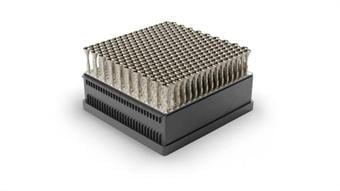
Watch: Engineers demo a FLARE for calibrating satellite sensors
S. Himmelstein | August 06, 2020Satellite sensors are calibrated prior to launch, but many of these instruments are short-lifetime imagers with high optical resolution and limited or no means of internal calibration and image verification. Sensor signals drift and change while in orbit, leaving researchers without the means to adjust the devices and boost data accuracy. A new device designed by electro-optics company Labsphere is being field-tested by imaging engineers at South Dakota State University to demonstrate in-orbit calibration capability.
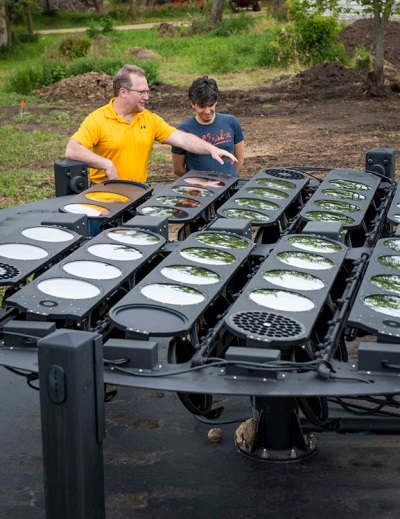 The FLARE system uses convex mirrors to redirect the sun’s rays toward satellite sensors. Source: South Dakota State UniversityThe Field Line-of-Sight Automated Radiance Exposure (FLARE) system was designed for on-demand radiometric calibration of high, medium and low spatial resolution sensors. The approach incorporates SPecular Array Radiometric Calibration (SPARC) technology, which uses convex mirrors to create two arrays of calibration targets for deriving absolute calibration coefficients of Earth remote sensing systems in the solar reflective spectrum. An array of single mirrors serves to oversample the sensor’s point spread function and generate the spatial quality data needed to perform the radiometric calibration of a sensor when viewing small targets. A second set of panels consisting of multiple mirrors is designed to stimulate detector response with known at-sensor irradiance traceable to the exo-atmospheric solar spectral constant.
Measurements are analyzed with an atmospheric model to predict what the satellite sensors see and enable accurate adjustment by Earth-bound engineers. By using mirrors to redirect the sun’s rays toward satellite sensors and take radiometric measurements, the cloud-based service offers a cost-effective means of calibrating optical sensors on unmanned aerial vehicles, airborne manned aircraft and orbiting satellites.
Validation testing of FLARE at the South Dakota site will continue for 18 months.