3 ways manufacturers can benefit from diversifying strategy
Jonathan Fuller | July 08, 2020When operating a business, strategic diversity can be defined in a few different ways. The one constant for fabricators and manufacturers is that adopting it in any form can provide significant benefits if done correctly.
Below are three ways fabricators can diversify their companies.
Markets
Small and midsize manufacturers (SMM) often get off the ground as moonlighting operations for a single individual. With sufficient growth, these part-time ventures can become full-time shops with staff ranging from a few employees to several dozen. Because of their small origins, SMMs often work by a version of the well-known 80/20 rule: 80% of their sales and work come from 20% of their customers, which often equates to only one or two clients.
This arrangement works great while the bigger clients are buying. But it can also encourage complacency and overspecialization in one market. Plus, a shop’s business can turn on a dime if the clients decide to move to a discounted supplier, outsource their fabrication or experience an economic downturn in their industry. This problem can be mitigated through market diversification.
Leveraging a key differentiator is critical to market expansion. When clients move to a discount supplier or outsourced operation, they typically trade savings for increased time to complete a job, so for SMMs speed is often the key to diversification success.
Increasing speed can be difficult, but it is possible with some strategic maneuvering. If an SMM has multiple locations, consolidating into one location and vertically integrating all design, fabrication and finishing operations can increase efficiency. Cross-training staff can also ensure that jobs are completed quicker and with consistent quality. On the contrary, other SMMs may find it more prudent to expand geographically to reach more customers.
Profiling potential customers is another strategy for well-informed market diversification. For example, a small fabricator losing customers to outsourcing can research specific customers in need of rapid, just-in-time service and lead with their speed and agility to secure new business.
Processes
Diversifying equipment and processes can bring similar benefits to moving into different markets. Updating production infrastructure can enable a fabricator to increase capacity, quality and speed. Investing in a single versatile machine like a modern, high-quality lathe or waterjet cutter can allow shops to take on more jobs.
Fabricators should also have their eyes open to partnership opportunities. Joining with a customer or even a competitor can allow a smaller, specialized shop to serve more clients or expand their portfolio with existing ones.
Staff
For decades, a considerable amount has been said and written about the benefits and importance of a diverse workforce. Most companies of any size are aware that diversity can have a positive effect on their culture and other aspects of the business.
While hiring across multiple genders, ethnicities and races is obviously paramount, other factors like age and a candidate’s previous experience can also represent positive diversifying. As Welding Digest covered in February, millennials may have differing views on workplace habits than a business’s longtime employees, but they can use their unique strengths to drive changes to make organizations more flexible or create positive changes for workplace culture.
While most manufacturers have a good idea of who they would look to hire if given the opportunity, considering a candidate from a drastically different industry or with diverse experience can create unexpected benefits. While it can be risky, bringing in an employee with connections to a fringe industry like healthcare can inspire expansion into that industry or open doors to new opportunities.
Risks and drawbacks of diversification
While it is easy to paint a rosy, positive picture of market and product diversification, knowing when, how and why to diversify can be difficult. Depending on a fabricator’s operations, market, product and overall strategy, expanding into different products and markets can create major growth. For some, concentrating all efforts on a single product or process is a better strategy.
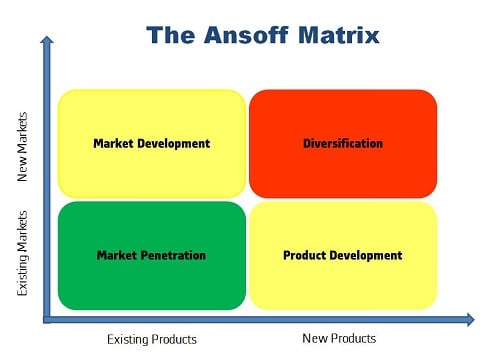 Figure 1: The Ansoff Matrix, developed in the mid-1950s, shows that while diversifying with new products in new markets is the riskiest strategy for growth, it can have the best outcome if executed properly. Source: JaisonAbeySabu/CC BY-SA 3.0
History is full of stories about diversification success and failure. General Electric, founded as an electric company in the late 19th century, was one of the most successful diversifiers of the industrial space in the 20th century until its struggles of the last decade, which saw the company divest many of its units. Corporate giants like Google, Apple and Amazon have an almost unbelievable success record for diversification, but it is safe to treat these as “black swan” companies whose success is difficult to replicate.
Manufacturers can start considering diversification by asking a few key questions. Does the company serve a limited geographic area, and what would it cost to expand that area? Is the main product changing or evolving its technology, and does the company have the capability to keep pace? Should the company rely on a single customer for a majority of monthly or annual business? What strengths does the company bring to each job, or can easily adapt to provide to new customers?
Answering these questions early and honestly can be the difference between choosing to remain focused on a single product, healthy diversification or overdiversifying to end up with a convoluted product portfolio that a business can neither sell nor maintain in the long term.