
Million-mile battery could end the internal combustion engine
Ryan Clancy, Mechanical Engineering HQ | June 18, 2020Contemporary Amperex Technology Co. Ltd (CATL), a Chinese car battery manufacturer has recently come out with a claim that its electrical engineering department has designed a new battery that is ready to be put into production, sporting a 1.2 million-mile lifespan. This huge Chinese company provides the car batteries that are used in some of the world's biggest car manufacturers, like Tesla Inc. and Volkswagen AG.
The development of a battery that can power a car for 1.24 million miles, or 16 years, is being recognized as an industry landmark and one of the big selling points for major car brands to sway customers to their electric vehicle (EV) models. Warranties on batteries used in current electric cars cover about 150,000 miles or eight years, according to Bloomberg New Energy Finance Ltd. (BNEF).
Expanding this lifespan is seen as a key advance because the option will be there to reuse the battery in a second vehicle, perhaps reducing the cost of owning an EV. Batteries are the most expensive part of EVs, and if the battery could be transferred from one car to another it would significantly lower the cost. Batteries losing their strength and having to be replaced after a few years is also one of the biggest concerns holding back sales of EVs. The new packs would cost about 10% more than the batteries now inside EVs, but this cost would be recouped from the extended lifespan that the batteries provide.
 Figure 1: The development of electric car batteries could be the key to converting a much higher percentage of drivers. Source: Sergii / Adobe Stock
Earth’s circumference at the equator is about 24,901 miles; that means a 1.2 million-mile battery could power a car for 50 trips around the world before it gave out. That is some serious mileage!
CATL hasn’t revealed details about the technology behind the extra-long-lasting batteries, but it is likely they involve some of the measures researched by a team at Dalhousie University in Nova Scotia, Canada.
The team was led by Jeff Dahn, a physicist and professor who partnered with Tesla to help the company advance its battery research. The battery uses lithium nickel manganese cobalt oxide (NMC) for its cathode (positively charged electrode) and artificial graphite for its anode (negatively charged electrode). The cathodes of existing batteries use small NMC crystals, but this one uses larger crystals, resulting in a structure that one researcher explained is less likely to develop cracks while the battery charges; that was one of the primary improvements contributing to a longer overall lifespan.
Another change was a reformulation of the material that carries ions between the battery’s cathode and its anode. Like its predecessors, the new battery uses a lithium salt with additives, and the Dalhousie team devoted a lot of research and time to optimizing the blend of ingredients.
The team openly shared details of their work in such a way that other researchers and companies could recreate the technology, saying they wanted it to serve as a benchmark in the field.
CATL’s business partners
Last year Tesla reported that it expected to bring a battery into production capable of 1 million miles in operation. Tesla had planned to launch its battery in China for the new Tesla Model 3, which is being built in a massive new factory near Shanghai, which started deliveries at the beginning of this year. This was followed by General Motors Co. stating last month that they are also nearing the milestone.
CATL is a nine-year-old company, but already has an all-star line of customers including the previously mentioned Tesla Inc. and Volkswagen AG along with the giants of Honda, Toyota Motor Corp., Daimler, a newly signed multi-billion-dollar deal with Volvo. They are also building a factory in Erfurt, Germany, to provide BMW AG with 70% of its automotive battery needs. Furthermore, CATL has also been in contact with Volkswagen’s Audi unit and is now cooperating with Porsche.
CATL is strengthening its relationship with Tesla, which is by far the most valuable EV maker and has a market capitalization of about $160 billion. They have been discussing matters such as cobalt-free lithium iron phosphate batteries that cut pack cost to $80/kWh, with Elon Musk leading the discussions with cost-based queries and Zeng Yuqun, chairman and founder of CATL, making sure that they have the solutions.
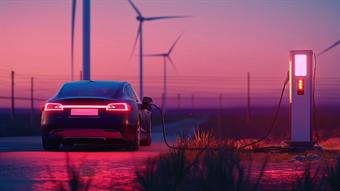
 Figure 2: Tesla Model 3 charging at one of Tesla’s many charging stations. Source: Aleksei Potov / Adobe Stock
Zeng said Musk also requested his help in obtaining ventilators for coronavirus patients. The U.S. billionaire delivered more than 1,000 of the breathing machines from China to officials in Los Angeles in March.
Demand for EVs
The buying of cars has been held up this year (2020) because of the current world situation, but this is creating pent-up demand that will be released starting next year, according to Zeng. BNEF predicts that EV sales could rise to 8.1% in China, the global leader in EV sales, and to 5% in Europe.
Zeng has stated that a “trigger point” for electric cars will occur once their sales surpass those of gasoline-powered cars, around 2030-2035. This is a slight margin more optimistic than BNEF, who predicts the cross-over to happen a few years later.
The United Kingdom (UK) has already hinted at the banning of new petrol and diesel cars completely as soon as 2032, in order to meet their zero-carbon emission targets. The UK government will even go as far as to offer drivers up to £6,000 to switch to an electric model next month, in an effort to boost the UK’s EV manufacturing industry.
There are also opportunities beyond cars with a battery like this, which Tesla is also said to be working on. The CATL packs are rated for 20 years of use in energy products like power arrays or storage, which will benefit the information technology (IT) industry. Reuters has claimed via sources close to Tesla, that the company is aiming for the sky with its new plans: “With a global fleet of more than 1 million electric vehicles that are capable of connecting to and sharing power with the grid, Tesla’s goal is to achieve the status of a power company, competing with such traditional energy providers as Pacific Gas & Electric."
What do you think about this new million-mile battery? Let me know your thoughts with a comment below!



I guess you won't need to buy a charger for this battery.
In reply to #1
Concept fail, Mildred. That figure is the operating lifespan of the battery and has nothing to do with the energy stored in it at any moment. Range anxiety and recharge time are the things holding electric vehicles back a bit at the moment.
In reply to #1
Concept fail, Mildred. That figure is the operating lifespan of the battery and has nothing to do with the energy stored in it at any moment. Range anxiety and recharge time are the things holding electric vehicles back a bit at the moment.
Very encouraging. Tesla's comments about the battery swap concept is smart and it opens the door to battery leasing in lieu of purchase which reduces the capital cost of the vehicle to the consumer.
Techapps.