Study algorithm finds HVAC sensor faults in smart buildings
Amy J. Born | June 03, 2020Smart buildings rely on technology to improve the energy efficiency of costly HVAC systems. However, faults occur often with these systems and are difficult to diagnose. Professor Marios Polycarpou, director of the KIOS Research and Innovation Center of Excellence, Cyprus, led a team of researchers who developed a distributed sensor fault diagnosis algorithm to detect and isolate multiple sensor faults in large-scale, smart building HVAC systems.
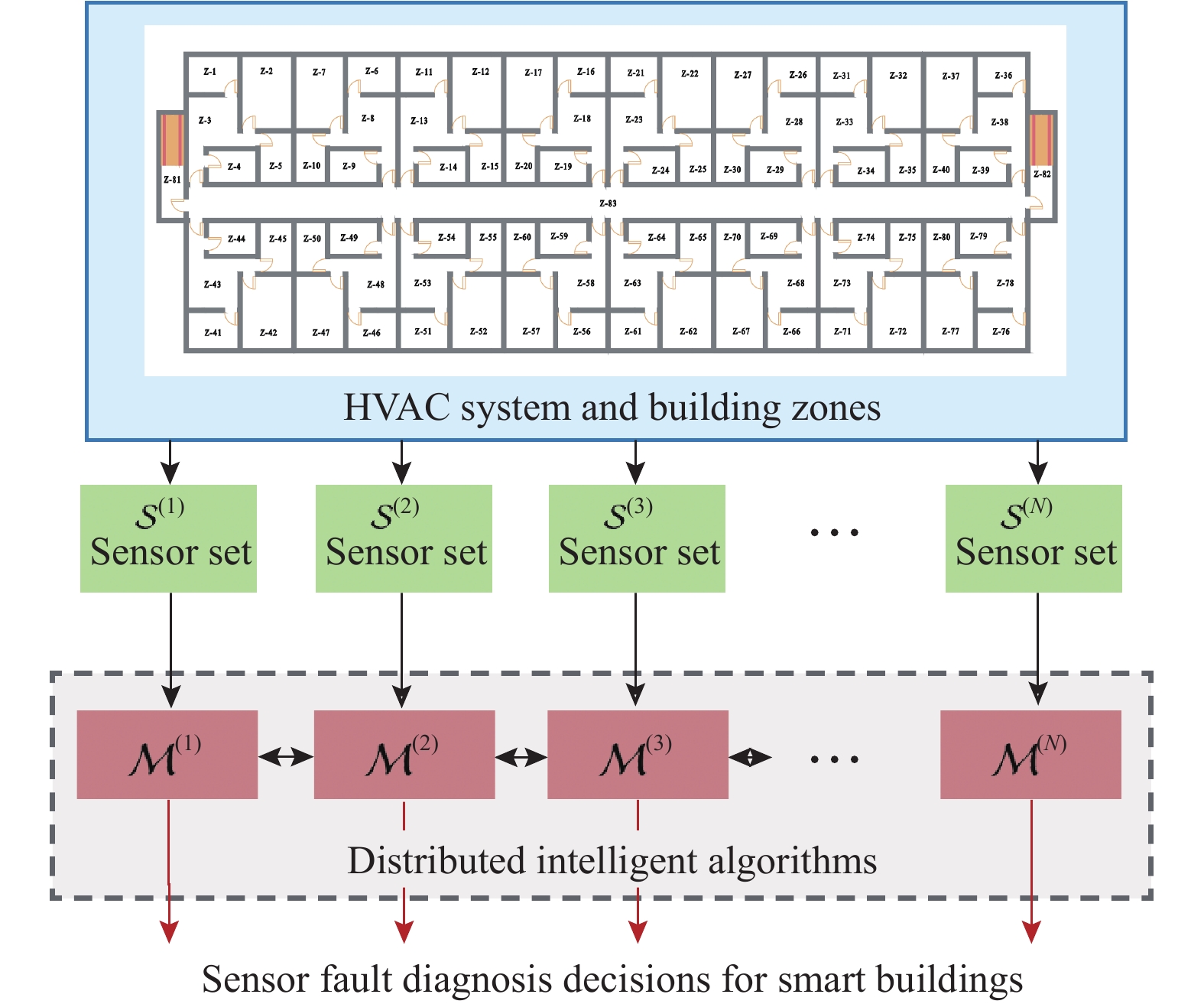 Architecture of the distributed sensor fault diagnosis scheme for smart buildings. Source: Panayiotis M. Papadopoulos, Vasso Reppa, Marios M. Polycarpou and Christos G. Panayiotou"The operation of Heating, Ventilation and Air-Conditioning (HVAC) systems in our homes, work spaces and public indoor spaces are based on the use of feedback measurements from sensing devices to make adjustments for maintaining a desired temperature. The presence of faulty measurements disorients the system and may create uncomfortable indoor conditions and/or significantly waste energy," said Polycarpou.
The algorithm is a sequence of clearly defined instructions that can be implemented by a computer to notify a building's operators of faulty measurements and the location of faulty sensors. It can be applied on existing building management systems or on plug-in internet of things (IoT).
The study model looked at the HVAC as a network of 83 building zones in interconnected subsystems rather than as one large global system. This approach makes diagnosing faults easier as well as scalable. "In this framework, a wireless smart sensor can communicate with its neighboring sensors to enhance the fault diagnostic process in terms of reliability, robustness, sensitivity, and scalability," Polycarpou explained. The goal, he added, is to create lifelong systems to diagnose and self-heal sensor faults.
The team's findings are published in IEEE/CAA Journal of Automatica Sinica.