Team improves durability of flexible electronics with solution inspired by the construction industry
Marie Donlon | May 18, 2020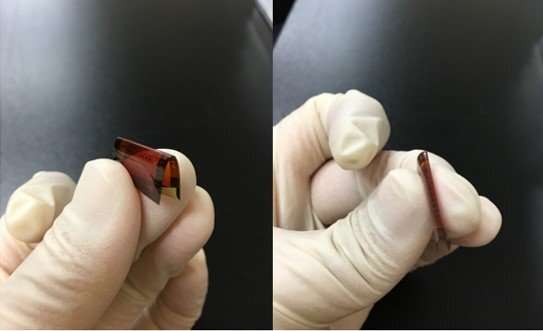 Repeated bending causes irreparable damage to flexible conductors in the form of microscopic cracks. Source: DGISTResearchers from South Korea’s Daegu Gyeongbuk Institute of Science and Technology (DGIST) have developed a technique for improving the durability of thin film flexible electronics.
Taking inspiration from the construction industry wherein steel plates with holes are used to reduce stress on a structure, the researchers drilled microscopic holes in a zig-zag pattern in standard flexible conducting film used in flexible electrodes and transistors to re-distribute and reduce stress on the material.
A problem plaguing thin film flexible electronics — such as wearable smart devices, health sensors and solar cells, to name just a few — is that the material bends, which causes microscopic cracks that eventually lead to the failure of the device.
Such cracks tend to form in unexpected locations along the film when bent. Yet, once the researchers drilled micrometer-sized holes into the film, distribution of stress on the material was altered and the subsequent cracks following bending formed along the edges of the holes and only propagated over short distances.
According to researchers, the film featuring the microscopic holes maintained conductivity following an estimated 300,000 bending cycles.
An article detailing the research, titled Stress Release Effect of Micro-hole Arrays for Flexible Electrodes and Thin Film Transistors, appears in the journal ACS Applied Materials & Interfaces.