
New microbes can quickly degrade plastic in hot environments
Siobhan Treacy | April 29, 2020Researchers from Qingdao Institute of Bioenergy and Bioprocess Technology (QIBEBT) of the Chinese Academy of Sciences have engineered a microbe that can break down polyethylene terephthalate (PET). The engineered microbes break down plant-based fibers.
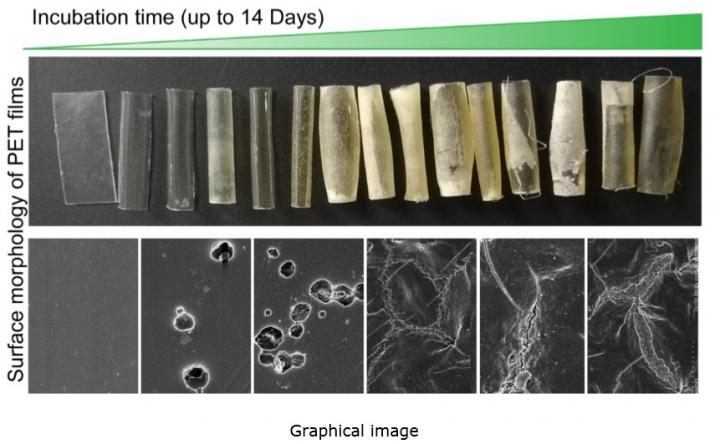 SEM analysis of PET films during biodegradation using C. thermocellum whole-cell biocatalyst at 60° C Source: LIU Yajun
Currently, the global economy is reliant on PET. Around 70% of fibers used in clothing production contain PET and consumer packaging products and drink bottles are produced with PET. Non-recycled PET is produced from fossil fuels. According to the Environmental Protection Agency (EPA), only 30% of U.S. plastic waste was recycled. Most of the plastic ended up in landfills or in the ocean.
Recycling centers that biodegrade PET typically use microbes that require oxygen and lower temperatures. These processes are expensive and energy-intensive. The new process overcome these issues
The process is based on a bacteria named Clostridium thermocellum (C. thermocellum). C. thermocellum is found inside leaf and branch compost piles. This bacteria can degrade PET more efficiently than current methods. The team chose this bacteria for its potential to thrive in hot and oxygen-free environments. C. thermocellum naturally degrades, which means it has great potential for applications in bio-recycling for mixed textile waste containing cellulose and polyester fractions.
The team gathered microbes that thrive above 60° C. This is the ideal temperature for degrading PET into component compounds.
To test the new compound the team submerged a thin PET sample in a solution rich with C. thermocellum. The test vials were kept at 60° C. After two weeks, two-thirds of the PET had broken down into feedstocks of hydrocarbon-based compounds that can be used to create plastics and other products. Existing whole-cell biocatalyst processes degrade take six weeks to completely degrade PET.
The new process has the potential to save PET recycling centers energy, time and money. It will also divert a large percentage of PET away from landfills and oceans.
A paper on this research was published in Microbial Biotechnology.
Certainly it's good to get plastics out of oceans, and biodegradability helps there. We are saying we'd rather have the plastic turn into CO2 than chemically and physically pollute the ocean (assuming it floats and doesn't go to the bottom).
But on land you have the opposite problem-- you want LESS degradation. Plastics in landfills should last long, and NOT turn into methane. It's far better that they do what most naturally want to do, which is to stay in the landfill for geologic amounts of time, as if they were still fossil fuel and had never been converted to plastic. That represents carbon which has been "captured" and "sequestered" for near-free. Making less stable plastics for land-end-disposal just interferes with a system that works well naturally (landfill, if it is deep, works even to "capture and sequester" carbon in paper, which means it does so for the CO2 used to make the paper).
To sum up: before deploying this degradation technology for any plastic use, some thought and work needs to be put into figuring out where the plastic will go otherwise. If into deep landfill, we might NOT want to use degradable plastics, and thus get rid of carbon that way.