Information modeling for the digital thread
Jonathan Fuller | April 01, 2020Digital twinning and digital threading are two of the most talked-about concepts in the world of the industrial internet of things (IIoT). Digital twins are exact virtual copies of a machine or plant, and the digital thread refers to the process of tracking details about a part, machine or facility throughout its history. Some of the end benefits of these activities include lower maintenance costs, better productivity, more precise inventory control and less risk.
But these benefits will stay small without some degree of data interoperability. Without it, each organization creates its own data scheme, which is useful to its creator but becomes much less useful when trying to communicate with suppliers, clients and other third-party stakeholders.
Think about the seamless integration of a library catalog search. If a user does not find what he or she is looking for at a local library, the exact item can be located anywhere within in the library system and obtained within a few days. If not in the local system, the exact item can easily be located within any other library in the world.
This interoperability is made possible by the machine-readable cataloging (MARC) format, which was adopted as an international standard in 1973. Because every item uses the same data format, retrieval is seamless even among disparate organizations. Of course, data standards exist in most every industry outside of the library world as well.
With the continued evolution of big data and digital threading and twinning, the industrial world needs standard information models more than ever, whether it knows it or not. Digital twinning and threading are relatively simple concepts, but many who jump into building these processes underestimate the process and cultural transformations, including new information modeling, that must occur.
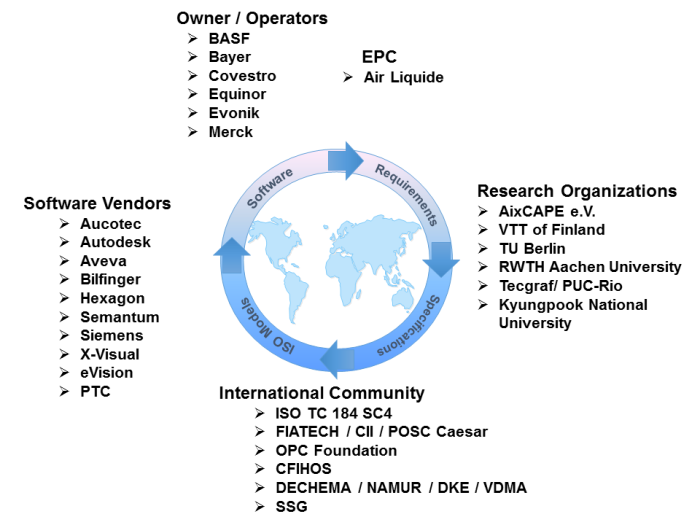 Figure 1: Major players in the development of the DEXPI standard. Source: DEXPIThe process industry, featuring complex manufacturing plants and specialty chemical products, has seen several data exchange initiatives to allow more powerful digital modeling. Data EXchange in the Process Industry (DEXPI), a working party of the ProcessNet initiative in Germany based on the ISO 15926 standard, is a prime example. It aims to address the interoperability challenges between computer-aided engineering and other systems in the process industry, making design, operations and maintenance information between engineering, procurement and construction (EPC) organizations, owner-operators and vendors seamless.
The German process industry automation user group NAMUR is also focused on interoperability in the industry. The in-progress NAMUR Open Architecture (NOA) model looks to standardize information sharing for field equipment monitoring and optimization applications, for example. NAMUR’s Asset Lifecycle Data Management (ALC) project is aiming to optimize data flow needed to develop, plan, operate and maintain plant assets.
NAMUR ALC is based on the DEXPI standard. Like DEXPI, it closely follows ISO 15926, which focuses on the design and build phases of plant assets. Process industry data standards also reference ISO 18101 and ISO 14224, which complement ISO 15926 by supporting information and maintenance data exchange with operations and maintenance service providers.
The public is most familiar with digital twinning and threading through the futuristic 3D models and automated public demos showcased within the past few years. But the widespread implementation and utility of the forward-looking concepts will rely on backend, perhaps less alluring, data modeling and standardization.