Designing solar cells for submerged service
S. Himmelstein | March 27, 2020Silicon solar cells traditionally used for land-based applications are of limited value for underwater service, such as powering submerged autonomous vehicles and sensors. The narrow band gap of these devices is constrained to the absorption of infrared and red light, which is also absorbed by water and unavailable at depths greater than 2 m. The potential to deploy wider bandgap semiconductors that harvest visible light in the 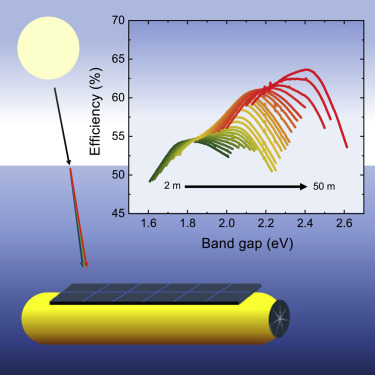 Underwater solar cells can produce useful power at up to 65% efficiency. Source: Jason A. Röhr/et al.underwater environment was explored by New York University researchers.
A theoretical model was developed to determine ultimate efficiency limits for underwater solar cells assembled with optimal materials. The detailed balance limit of efficiency model considers bandgap energy of different semiconductors, depth below sea level and absorption spectra documented for major oceans and lakes. The analysis shows that shifting from shallow waters of 2 to 4 m depth to deeper waters, the ideal band gap changes from 1.8 eV to 2.4 eV, with a plateau at 2.1 eV between 4 and 20 m.
The research reported in Joule indicates that underwater solar cells have the potential to harvest power at depths up to 50 m in very clear waters with efficiencies of 55% to 65% and generate 5 mW/cm2 or more. These devices might also be deployed in cloudy waters at depths up to 10 m.
Polymeric semiconductors used in the manufacture of organic solar cells could be candidate materials for underwater solar cells. Wide-band-gap organic semiconductors developed for light-emitting diodes and field-effect transistors, such as rubrene and pentacene, are also identified as promising options for solar cells operated at depth.