Nanosheets decimate superbugs during wastewater treatment
S. Himmelstein | March 16, 2020Available disinfection technology can deactivate superbugs, or antibiotic-resistant bacteria, in wastewater but is unable to target similarly resistant genetic material that remains for possible transfer into other microbes. A method for photocatalytically eliminating antibiotic resistance genes (ARGs) from municipal wastewater systems was demonstrated by Rice University researchers.
The approach uses graphitic carbon nitride nanosheets with molecular imprints designed to only capture ARG. 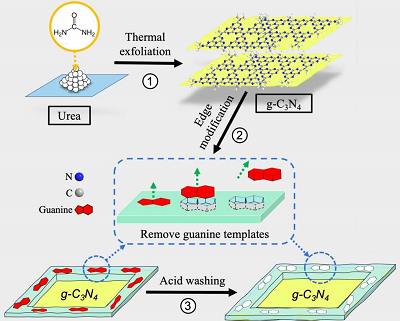 Schematic of the three-step method to produce molecular-imprinted graphitic carbon nitride nanosheets. Source: Danning Zhang, Rice UniversityThe DNA base guanine is embedded in methacrylic acid-coated nanosheets and then removed with hydrochloric acid, leaving guanine molecule-shaped holes. Genetic material captured by the adsorptive nanosheets are destroyed by ultraviolet light.
When tested with secondary effluent containing New Delhi metallo-beta-lactamase 1, known to resist multiple drugs, the nanosheet-UV light treatment proved 37 times more effective than bare graphitic carbon nitride in destroying ARGs.
The researchers are continuing to optimize the molecular imprinting process to enhance the selectivity and efficacy of photocatalytic processes to mitigate dissemination of antibiotic resistance from sewage treatment systems.