
Watch: Autonomous vehicles may be vulnerable to phantom objects in their path
David Wagman | February 12, 2020Researchers projected a phantom image on the road in front of a semi-autonomous car's autopilot and caused the vehicle to brake suddenly.
By doing so, the researchers said they demonstrated that autopilots and advanced driving assistance systems (ADASs) in semi-autonomous or fully autonomous cars consider depthless projections of objects (phantoms) to be real objects. Of concern is that attackers may be able to exploit this perceptual challenge and manipulate a car into endangering its passengers.
The researchers from Ben-Gurion University in Israel said they also demonstrated that attackers may be able to fool a driving assistance system into believing fake road signs are real by disguising phantoms for periods of time as short as 125 milliseconds in digital billboards located near roads.
The researchers said that while the deployment of semi/fully autonomous cars is underway around the world, the deployment of vehicular communication systems is not as advanced. These systems connect the car with other cars, pedestrians and surrounding infrastructure. The lack of such systems creates a “validation gap" which the researchers said prevents semi/fully autonomous vehicles from validating their virtual perception with a third party, requiring them to rely solely on their sensors.
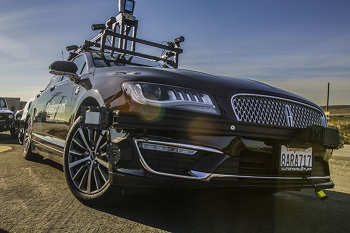 Projecting a phantom of a person can trigger a car to suddenly brake. Source: US Department of DefenseThe researchers showed that projecting a phantom of a person can trigger a car to suddenly brake, while a phantom image of lanes can cause its autopilot to veer into the oncoming traffic lane.
"This is a fundamental flaw in object detectors that essentially use feature-matching for detecting visual objects and were not trained to distinguish between real and fake objects," said one researcher.
In practice, depthless objects that are projected on the road are considered real even though depth sensors exist. The researchers said they believe that this is the result of a “better safe than sorry" policy that causes the car to consider a visual 2D object real.
The researchers also demonstrated a method to remotely conduct attacks by projecting a phantom road sign from a drone, and disguising a phantom road sign in an advertisement for 125 milliseconds screened on a digital billboard alongside a road.
Although previous attacks that exploited the so-called validation gap required attackers to approach the scene of the planned attack, the researchers showed that remote attacks do not require any special expertise and can fool advanced systems with a drone and a projector.
In order to detect phantoms, the researchers are developing a convolutional neural network model that analyzes a detected object's context, surface and reflected light, which is capable of detecting phantoms with high accuracy.


The plot thickens . . . .
Phantom objects are one method to muck about with smart vehicles. I have encountered uncivilised pedestrians who make eye contact then step in front of a regular vehicle, causing the driver to brake hard so they may cross. Once such a-hole pedestrians know every car (autonomous or driven) has automatic pedestrian safety braking, we will see multi-car front-to-rear pile-ups thanks to the a-hole pedestrian deliberately walking in front of the first vehicle, confident he will be safe, laughing at the expense of a dozen bent vehicles.
In reply to #2
<sigh>, . . . yeah, I could believe that might start to happen.
In reply to #2
Yeah - I've met that guy.
The confidence may be misplaced though as the second car's impact could throw the first car into the a-hole. If the following vehicle is a much larger one it cold be quite violent.
In reply to #2
Years ago I had some clown start crossing the road mid-block without even looking at me, knowing that I was driving towards him. I was driving a stick shift at the time. I shifted the car into neutral and hit the gas, causing the engine to roar but go no faster (just coast). The idiot heard the engine Rev High and immediately BOLTED to the sidewalk, looking my way in panic as I coasted by him laughing hysterically. I definitely got his Full Attention that afternoon. Still gives me a chuckle to this day.
One benefit of people doing this in front of an autonomous vehicle is that you have your hands free to roll down your window and toss them a nice cold beverage, possibly making a new friend.
;8 D