Solving the OLED problem for high-brightness applications
Amy J. Born | February 10, 2020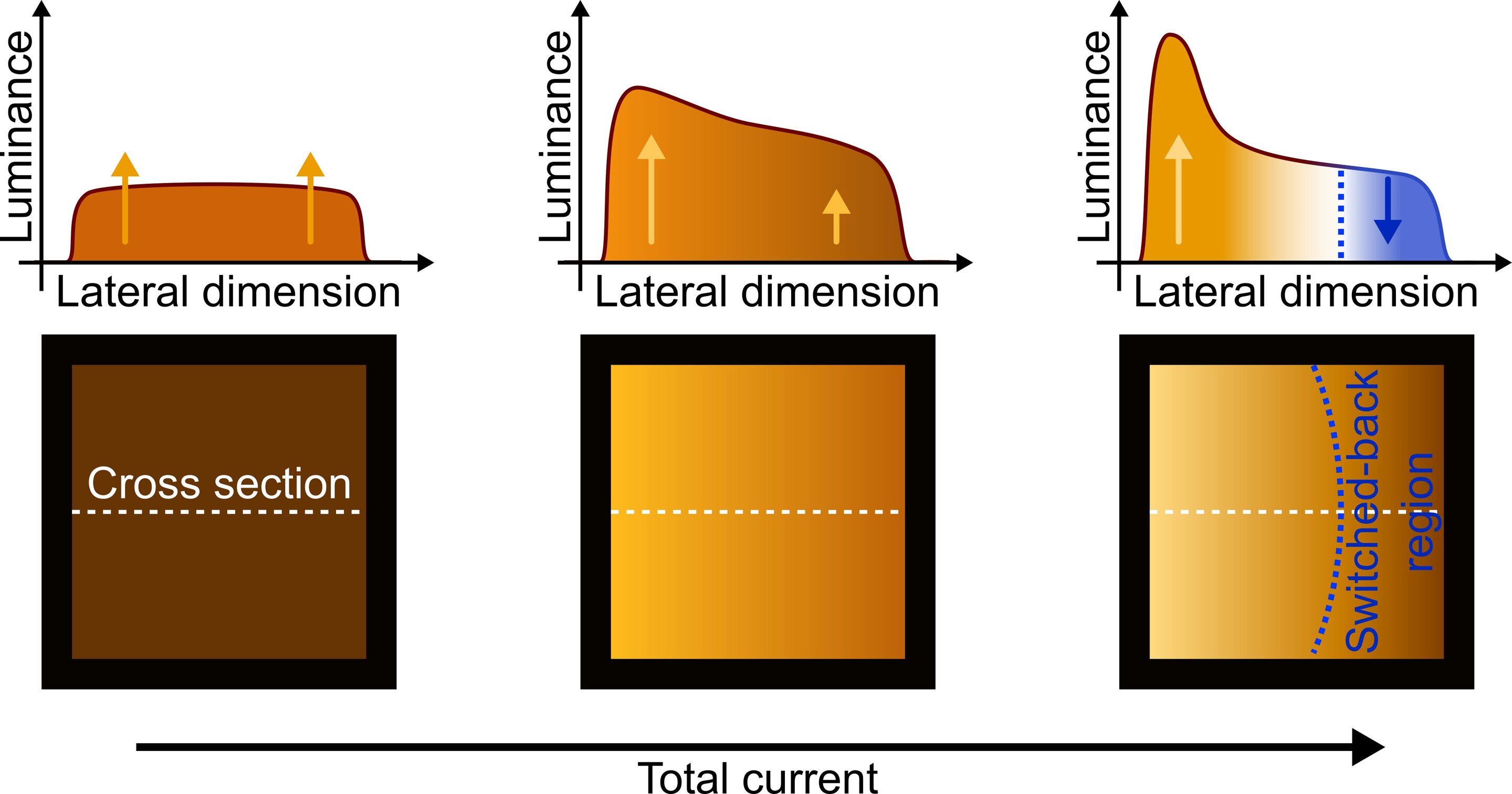 Proof of switched-back regions by detecting luminance changes in OLEDs: The bottom line of the figure presents the top-view sketches onto an OLED pixel at three different exemplary stages of total applied current. The top-line estimates the luminance profiles across the indicated cross section. While low driving currents result in a homogenous luminance distribution (left column), elevated currents give rise to a gradually decreasing luminance profile (middle column). After exceeding a certain threshold current, the luminance will even reduce ("switch back") in certain areas of the device (right column). Source: Anton Kirch, Axel Fischer, Matthias Liero, Jurgen Fuhrmann, Annegret Glitzky, Sebastian Reineke
Due to new design possibilities, OLEDs (organic light-emitting diodes) are being considered as potential replacements for LEDs in tail lights, brake lights and signal lights on cars, and for other applications in lighting and signage that require high brightness. However, OLEDs have an issue of inhomogeneous light emission if they heat up.
Researchers from TU Dresden and the Weierstrass Institute Berlin have proven experimentally that despite an increase in the total applied current, an area of the OLED will suddenly get darker. Using a two-dimensional OLED model, the researchers concluded that "these regions are switched back locally in voltage as well as current due to insufficient lateral thermal coupling." They found that the effect "becomes more severe with increasing pixel size, which implies its significance for large-area, high-brightness use cases of OLEDs."
The team used a camera to detect the emission that corresponds to the local current flow and observed decreasing brightness just prior to the OLED beginning to degrade, which indicated proof of switched-back regions. As confirmation of their experimental results, current and heat flow were studied numerically in a highly nonlinear system with a simulation tool. The numerical simulation, based on reasonable assumptions and parameters, was able to reproduce the experimental finding.
The researchers believe the switched-back regions may also be related to sudden-death phenomena, the rapid decrease of light output with time associated with OLEDs. Though their occurrence has not been well-documented due to their random and unpredictable nature, a better understanding is necessary for predicting device breakdown and for improving brightness uniformity and device stability.
The group is looking for partners from science and industry to apply the results from lab-scale OLEDs to larger thin-film lighting panels and more complicated geometries. The next challenges are finding ways to homogenize the luminance and prevent the switched-back regions, and to further study the relationship between switched-back regions and sudden-death scenarios.
The study is published in Nature Light: Sciences Applications.