
Video: Designing diamond batteries powered by nuclear waste
S. Himmelstein | January 23, 2020Spent graphite waste stored at the U.K.’s Berkeley nuclear power plant, decommissioned in 1989, can be put to 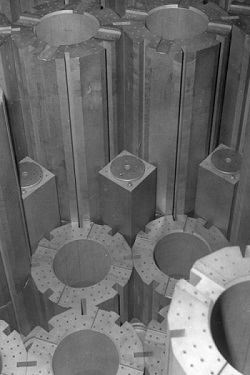 The structure of graphite blocks in a nuclear reactor. Source: EDF Energyuse as the basis for diamond batteries. University of Bristol researchers are developing the technology to extract carbon-14 from the radioactive graphite to power the devices.
The carbon-14 concentrated at the surface of graphite blocks used to sustain reactions in nuclear power plants can be encased in diamond, which offers protection to humans by containing the radiation. The radiocarbon has a half-life of 5730 years, ensuring a long service life for the power units.
The researchers have already developed an artificial diamond that produces an electrical current when placed in a radioactive field and are now advancing ultra-low powered sensors that harvest energy from radioactive decay. The technology can reduce the radioactivity of stored nuclear waste and might find application in powering pacemakers and other medical devices or as power supplies for spaceflight missions.



This sounds interesting/promisin
I found this interesting. However, there is a very recent scientifically based critique of the idea that needs to be addressed.
https://www.youtube.
NUCLEAR Diamond Battery: BUSTED!!
126,116 views •Jan 30, 2020