
Video: Battery generates clean power for rural users
S. Himmelstein | January 16, 2020Lack of access to conventional electricity supplies keeps many residents in resource-limited areas in the dark at 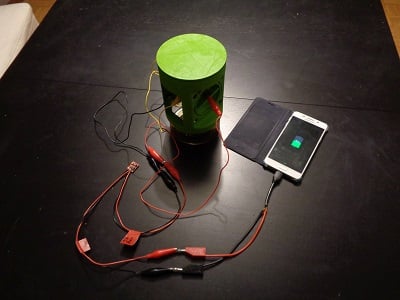 The reusable battery can power an LED bulb for five hours or charge a cell phone. Source: HiLytenight without the means to charge cell phones or the light needed for students to study. A new battery device engineered at École polytechnique fédérale de Lausanne, Switzerland, can offer a sustainable, affordable solution to provide power in these regions.
The reusable battery is assembled with commonly available materials — iron, water, coffee filters and carbon felt — and can power an LED bulb for five hours or charge a cell phone. The solid components are placed in each of the four compartments comprising the device, followed by the addition of water and iron sulfate powder. The slow dissolution of the iron foil releases electrons that can be tapped for power production by coupling the battery to a lamp or other appliance.
The battery incurs half the costs of kerosene and is an environmentally preferred energy option, as the iron sulfate byproduct can be safely discharged. Startup HiLyte is currently field testing the battery in Tanzania, with plans to expand its availability in other regions.



What is the availability & cost of the iron sulphate?
In reply to #1
That's a good point. It seems to me that a better solution would be either using solar panels (where sunlight is available) or maybe a Sterling engine powering a generator (where anything can be burned to produce heat).
The important thing is not depending on consumables which may not be easily obtainable.
In reply to #3
So, in a place that has access to cellular phones, cellular service, and LED bulbs, you are seriously concerned that they won't be able to obtain the expendables? I'm quite sure this is a little bit unfounded. I'd much rather rely on a $12.00 system with 10-cent-per-day expendables than anything solar. Not to mention the documented environmental impact of the production of solar panels, plus the additional E-O-L impact. Give me the chem-reaction system ANY day [or night].
First world solutions rarely solve third world problems historically.
very nice information about the battery generates clean the power for the user and more useful human alternative sites to einthusan
There is no battery that GENERATES POWER as the title says . All batteries are just store houses of energy and release it, as needed . Any batteries need to be charged from a source of power .
In reply to #5
No, that's either a capacitor or a rechargeable battery or 'accumulator' in old-speak.
A battery or cell is a device that converts chemical energy to electrical energy. Theoretically, the process is reversible, but most older battery technologies make that impracticable. Lead-acid and nickel-iron alkali (are you old enough to remember that?) were exceptions until NiCd began a slow revolution. The modern rechargeable lithium cells are only made practicable by fancy electronics which keeps their charge-discharge parameters within very strict limits.
This battery appears to use ferric sulphate to oxidise iron to generate electricity. the ferrous sulphate that results could then be re-oxidised to ferric sulphate by air, but there would still have to be a supply of acid sulphate for that to work, and the iron would still be consumed, so I think this is still probably a one-way process.
Could this small battery be made considerably bigger in order to be used for cooling, heating, cooking, running a dish washer etc? Could it be used for accumulating solar energy? Would this be economically feasible?