
Researchers report progress in tire recycling technology
S. Himmelstein | January 16, 2020Stockpiles of discarded automobile tires might soon shrink with the advent of a process designed to recover 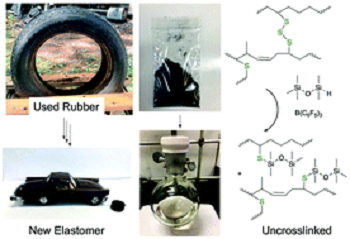 A one-step technique recovers polymeric oils by breaking the sulfur-to-sulfur bonds responsible for the durability of modern tires. Source: S. Zheng et al.petroleum-based polymers from these materials for reuse.
A one-step technique developed at Canada’s McMaster University recovers polymeric oils by breaking the sulfur-to-sulfur bonds responsible for the durability of modern tires. Sulfur crosslinks were degraded by use of tris(pentafluorophenyl)borane, a compound with strong Lewis acidity commonly used in catalytic applications. The method effectively reduced sulfur-sulfur bonds in samples of tire crumb, solid tires and bicycle inner tubes, yielding organic polymers.
The recovered polymeric oils can be filtered and upgraded to form new elastomers, as was demonstrated by synthesizing a new automotive tire for a child’s toy by use of oxidative crosslinking reactions.
The technique described in Green Chemistry is currently far too expensive to be scaled up for industrial applications, but the researchers hope to render the recycling technology more cost-effective with a view to wider applications.



Or you could use the energy extraction techniques of Tcmtech.
What happened to the tire shredding for re use in roads and other areas that was done several years ago. There was a company that was shredding tires in Oregon.
In reply to #2
Personally, I like the chunked tire mulch that you can buy. It is heavier than typical mulch, so you can leaf blow it (gently) and get leaves out without scattering too much of the mulch. I found I can even run my mower over the tire mulch and it doesn't scatter very much of it.
I do recall outdoor running tracks paved with an asphalt-rubber mixture that were a joy to run on compared to standard paving or packed dirt tracks. It didn't seem like it would have been durable enough for vehicular traffic though.
I had heard about adding a percentage of tire shreds to road pavement, but never heard about the longevity of those pavements.
I did find these links:
http://asphaltmagazi
https://www.fhwa.dot
https://en.wikipedia
https://www.recyclin
In reply to #3
I have not seen the chunk tire mulch. I will have to try to find some here in Wisconsin. This would be a good use and get rid of tons of tires as people use a lot of mulch.
In reply to #4
Here is one example (not an endorsement)
https://rubbermulch.
I have seen it for sale at all the big box home improvement stores in 40 lb. bags as well as at some of the "club" stores too. Usually around $8 a bag. More expensive than traditional mulch, but it lasts much, much longer.