Kirigami-inspired paper can autonomously transform into 2D shapes and 3D structures
Marie Donlon | December 17, 2019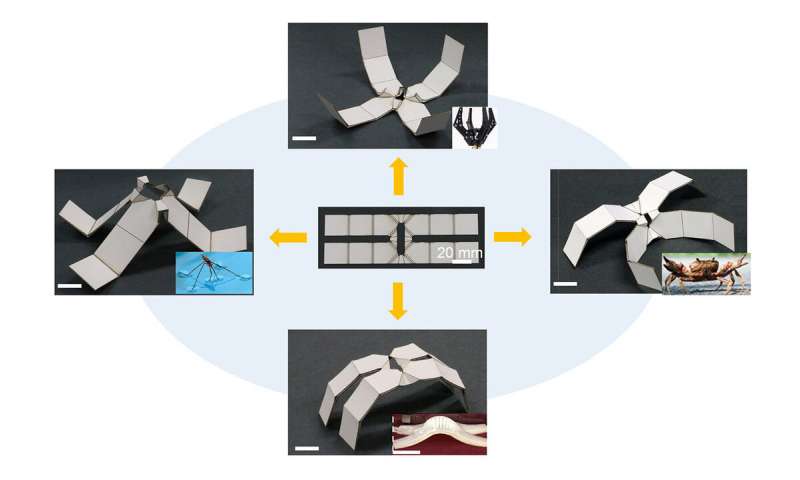 Researchers have demonstrated how kirigami-inspired techniques allow them to design thin sheets of material that automatically reconfigure into new 2D shapes and 3D structures in response to environmental stimuli. Source: Jie Yin, NC State UniversityA team of researchers from North Carolina State University have created a series of self-folding structures inspired by the art form kirigami, a form of origami wherein the paper can be cut instead of exclusively folded.
Layers of the kirigami-inspired paper, two layers of which serve as an outer layer and one central polymer layer that responds to heat, can autonomously restructure themselves to create both 2D shapes and 3D configurations without mechanical instructions, according to the team.
To achieve this, the researchers applied heat to enable the sheets of paper to rearrange themselves into 2D shapes and 3D structures. The ability to control the shape of the paper was due to through-cuts, which penetrate all the layers in the structure and enable the material’s range of motion. Likewise, etchings exposed the inner polymer layer to the outer layers and thus the heat, which controlled the angle, folding direction and folding distance the material achieved. While folding, the through-cuts open up, thereby transforming the shape of the material sheets, which emerge as 2D and 3D designs.
To demonstrate possible applications for the material, the team developed thermo-responsive kirigami machines such as devices capable of gripping and boxes capable of self folding.
To see those machines in action, watch the accompanying video that appears courtesy of North Carolina State University.
The study, "Programmable active kirigami metasheets with more freedom of actuation," appears in the journal Proceedings of the National Academy of Sciences.