E. coli engineered to dine on CO2
S. Himmelstein | December 02, 2019Researchers at the Weizmann Institute of Science in Israel have engineered a strain of the bacterium Escherichia coli that grows by consuming carbon dioxide, instead of sugars or other organic molecules. A combination of genetic manipulation and sugar starvation resulted in the evolution of an autotrophic strain 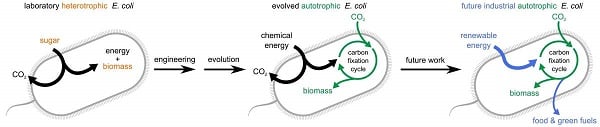 Researchers converted the sugar-eating (heterotrophic) E. coli bacterium (left) to producing all of its biomass from CO2 (autotrophic), using metabolic engineering combined with lab evolution. The new bacterium (center) uses formate to drive CO2 fixation by a synthetic metabolic pathway. The bacterium may provide the infrastructure for the future renewable production of food and green fuels (right). Source: Weizmann Institute of Sciencecapable of producing its own food and energy needs solely from atmospheric CO2.
The bacterium was edited with genes that encode a pair of enzymes that allow photosynthetic organisms to convert CO2 into organic carbon. The genetic insertion enabled E. coli to exploit formate as an energy source. Successive generations of the modified organism were then cultured for a year with exposure to limited quantities of sugar and CO2 concentrations about 250 times those in Earth’s atmosphere. After about 200 days, cells began to tap CO2 as their only carbon source and after 300 days, these bacteria grew faster under laboratory conditions than those that could not consume CO2.
The development, described in Cell, demonstrates a route to rapid laboratory-based evolution by means of synthetic biology, as well as a potential new technology for the sustainable production of chemicals and fuels from CO2.