
Team creates fully recyclable packaging materials
Marie Donlon | October 17, 2019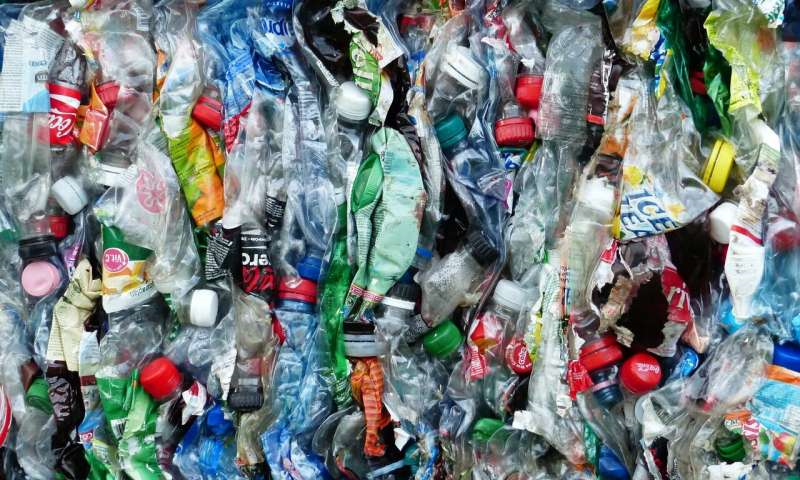 A team of researchers from the University of the Basque Country in Spain and Colorado State University have created packaging material that is fully recyclable.
To develop the new material, the team examined two different chemically recyclable homopolymers — poly(gamma-butyrolactone) and poly(trans-hexahydrophthalide) — and combined them to make copolymers, taking properties from each. For instance, poly(gamma-butyrolactone) demonstrates the appropriate rigidity, or mechanical properties, required of packaging while also demonstrating high permeability, meaning that its barrier likely would not hold up against assorted gases and vapors that could potentially impact food safety or quality. Meanwhile poly(trans-hexahydrophthalide) is highly rigid with low permeability.
To achieve the desired mix of low permeability and appropriate rigidity, the team altered the composition of both homopolymers and combined them to achieve the desired blend of characteristics. The result, according to the team, is packaging that challenges the performance of other biodegradable polymers currently in development.
What sets plastic apart as an ideal material, particularly for food packing are its light weight, high ductility and low permeability to vapors and gases. Combined, these characteristics serve to enhance packaged food safety and quality. However, plastic is generally non-recyclable and nonbiodegradable, which is why the world is now overwhelmed by the material as it occupies landfills and even the world’s oceans.
Although biodegradable alternatives to plastic currently exist, often it is at the expense of one of the desired properties offered by plastic. One such example often touted as an alternative to plastic is poly(lactic acid). Poly(lactic acid) is a biodegradable polymer that is a promising substitute for plastic. However, what sets it back is its high rigidity and high permeability.
The team has detailed their findings in the journal Nature Communications.

First of all, they are confusing recyclable with degradable. They are certainly not the same. They also imply that PLA is not a plastic, which depends on the chemical definition of plastic, which the public neither knows nor cares about. There is good reason NOT to use degradable packaging (carbon dioxide regeneration, products of degradability in soil, contamination of recycle streams) but the push to avoid "plastic" is very strong, and quite understandable given the packagers' need to satisfy their customers, who are scared by chemistry and anything unnatural, which has led to popular negative images of plastics, despite their benefits to both health and the environment via water-resistance, nonsupport of bacteria, light weight (fuel saving) and nontoxicity despite beliefs to the contrary.
The fear of synthetic is connected to the fear of miracle-denying science, easily challenged by noting natural dangers (snake venom, bacterial pathogens, even poison ivy) and synthetic life-saving compounds from insulin to aspirin. To many, however, it doesn't matter.