Refinery explosion stalls 10-year growth trajectory
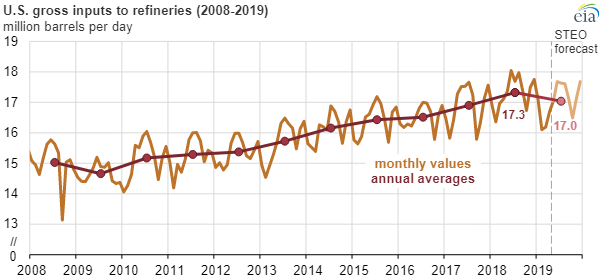
Engineering360 News Desk | August 16, 2019U.S. gross inputs to refineries, also known as refinery runs, rose each year since 2009, most recently reaching a record high of 17.3 million barrels per day (b/d) in 2018.
 Fireball erupts during the June explosion at the PES facility in Philadelphia. Credit: NBC PhiladelphiaHowever, based on its monthly refinery run data through last May and forecast for the remainder of 2019, the U.S. Energy Information Administration (EIA) said it expects refinery runs to decline and average 17.0 million b/d in 2019.
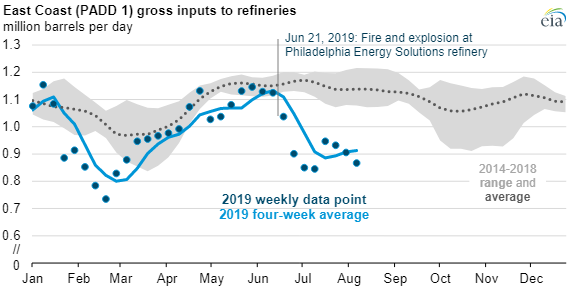
 Credit: EIAIn late June, however, damage from an explosion at the Philadelphia Energy Solutions (PES) refinery in South Philadelphia led PES to discontinue operations. The PES refinery had the largest refining capacity among East Coast refineries (335,000 b/d). In the weeks since the explosion, refinery runs in the East Coast region averaged 897,000 b/d, a decline of about 211,000 b/d from their averages in the weeks before the explosion.
U.S. refinery capacity was at a record high of 18.8 million barrels per calendar day as of January 1. EIA’s annual Refinery Capacity Report suggests that U.S. refining capacity will not expand significantly during the year.
 Credit: EIAU.S. refinery runs typically reach their highest points in the summer, when demand for petroleum products, especially motor gasoline, tends to peak. So far in 2019, weekly refinery runs have averaged 17.0 b/d through August 9. That is 1.4% lower than during the same period in 2018. Despite their overall lower rate, weekly refinery runs surpassed 18 million b/d in the week ending August 2, a level achieved seven times in the past decade, EIA said.
Refinery runs are expected to average 17.0 million b/d in 2019. EIA said it expects them to increase to 17.6 million b/d in 2020 due to increases in both refining capacity and utilization.