Researchers develop modular robots capable of reconfiguring themselves in 17 different ways
Marie Donlon | July 24, 2019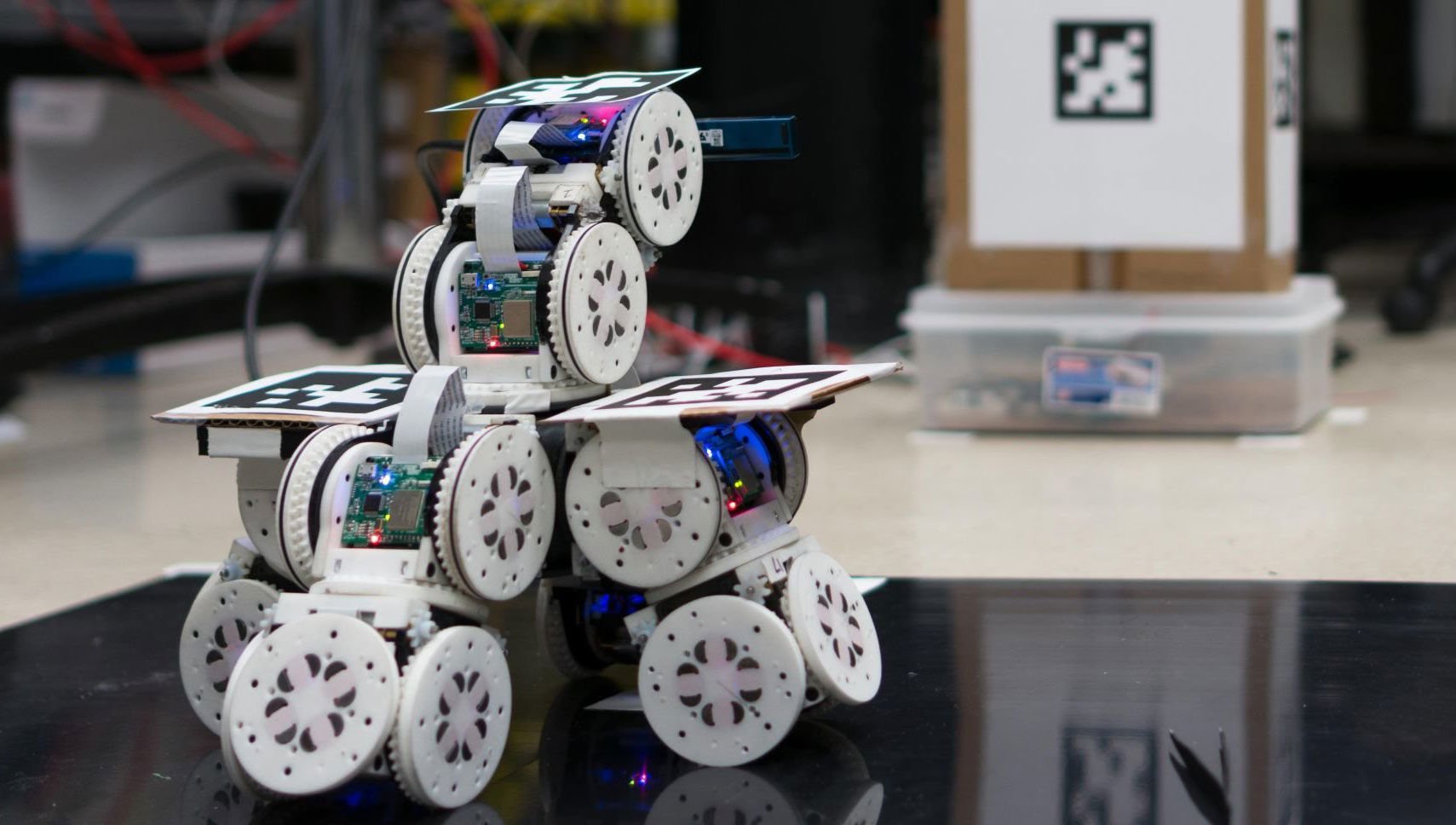 Source: University of Pennsylvania ModLab Researchers from the ModLab at the University of Pennsylvania have developed robots that are capable of reconfiguring themselves into other shapes.
The robots, dubbed SMORES-EP robots, communicate with each other by transforming the magnets located on their ends into short-range radios. Each wheeled module is outfitted with four connectors each, making it possible for every set of two robots to reconfigure themselves, connecting in 17 different configurations. As such, many units are able to join together to create one larger, more complex robot.
Yet, despite all that the ModLab team has accomplished in the development of the robots, configuring the robots presented a challenge. To reconfigure, changing from one form to another, the robots needed a plan that enabled them to move from their initial location to a new space — converting to a robot that walks, for instance, to one with an arm. To achieve this, the modules needed to be docked and undocked in specific ways. The researchers determined that to do this efficiently, configuring themselves from initial state to goal state, some configurations would need modules capable of assisting the others. In other words, one module would need to behave as a “helper,” navigating other modules into place to dock into a new position. Likewise, other configurations would rely on modules moving one at a time into a new shape.
Recognizing that, the ModLab research team believes that the modular robots are now more flexible and adaptable to standard robots, noting that they can also repair themselves and adapt to unknown environments. The team also suggested that the modular robots could prove useful during space missions or disaster scenarios. Additionally, researchers suggest that they could act as prosthetics for the physically disabled.
To see how the modular robots work, watch the accompanying video that appears courtesy of the University of Pennsylvania’s ModLab.