Make parts of Mars more inviting with this material
S. Himmelstein | July 16, 2019The prospects for colonizing Mars by terraforming have been dashed by NASA researchers. There is not enough carbon dioxide on the planet to provide significant greenhouse warming were the gas to be released into the atmosphere. Vaporizing the ice caps would only contribute enough CO2 to double the Martian pressure to 7% of Earth’s, presenting conditions far too inhospitable to support life planet-wide. However, a little silica aerogel 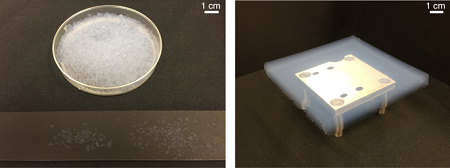 Left and right panels show the aerogel particles and an aerogel tile, respectively. Source: 2019, Springer Naturecould go a long way toward supporting photosynthesis on a regional basis on the red planet.
Researchers from Harvard University, California Institute of Technology and the University of Edinburgh demonstrated the warming potential of silica aerogel solid-state greenhouse layers under Mars-like insolation levels. Experiments showed that a 2 cm to 3 cm thick layer of the porous aerogel transmits sufficient visible light for photosynthesis, blocks hazardous ultraviolet radiation and increases temperatures underneath, permanently above the melting point of water.
Silica aerogel layers could be applied to greenhouses or domes for habitation, conducting heat and light as required, initially for the sustenance of photosynthetic organisms.
The material and technology described in Nature Astronomy will be tested in Mars-like climates on Earth, such as the dry valleys of Antarctica or Chile.