
Scientists turning plastic waste into jet fuel
Marie Donlon | June 05, 2019 Washington State University scientists have discovered a method for turning plastic waste into jet fuel.
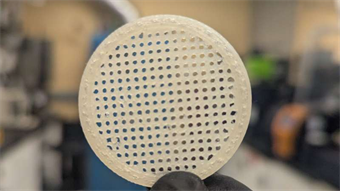
To manufacture the jet fuel, researchers melted plastic waste at high temperatures along with activated carbon — which is a type of carbon with small, low-volume pores that increase the available surface area for adsorption or chemical reactions. Researchers combined different plastic waste products, including plastic bags, water bottles and milk bottles, grinding them down to an estimated three millimeters in size (or roughly the size of a grain of rice). The ground plastic was then set atop activated carbon inside a tube reactor at temperatures as high as 430° C to 571° C (or 806° F to 1,060° F). Acting as a catalyst, the carbon expedited a chemical reaction, without being overcome by the reaction.
"Plastic is hard to break down," said Hanwu Lei, an associate professor in WSU's Department of Biological System Engineering. "You have to add a catalyst to help break the chemical bonds. There is a lot of hydrogen in plastics, which is a key component in fuel."
Once the carbon catalyst finishes, it can be filtered out and later re-used in another batch of waste plastic conversion. Likewise, the catalyst can be regenerated after losing its activity.
Following testing of several different catalysts at various temperatures, researchers concluded that the most promising result was the creation of an 85% jet fuel and 15% diesel fuel mix.
According to researchers, this method could potentially improve the state of crowded landfills that typically receive millions of tons of plastic waste each year, thereby reducing accumulating waste.
"We can recover almost 100 percent of the energy from the plastic we tested," Lei said. "The fuel is very good quality, and the byproduct gasses produced are high quality and useful as well."
Lei added that the new technique is easily scalable and could work at both large facilities or on farms, where farmers could transform plastic waste into diesel.
"You have to separate the resulting product to get jet fuel," Lei said. "If you don't separate it, then it's all diesel fuel."
The method is detailed in the journal Applied Energy.



finally we are breaking down plastics... what impact has the exhaust ? cleaner than the commercial jet fuel used currently?
So you can produce good quality fuel and recycle the carbon, but what do you do with the melted plastic at the end of the process - can it be used to make anything useful or does it all go back into landfill - how much energy does the process consume and how much waste gas, etc. does this cause.
As with a lot of eco-friendly solutions to the plastic waste problem the process sounds very promising, but I feel the article skips over a lot of side issues which could result in other problems.