
Polymer prepared to enhance uranium extraction from seawater
S. Himmelstein | May 24, 2019The sea may seem an unlikely source of uranium, but saltwater extraction offers a sustainable alternative to land-mining of the element to support nuclear power production. These resources are abundant in seawater through the natural erosion of ore-containing rocks and soil. The world’s oceans are estimated to contain four billion tons of uranium, a supply 1,000 times greater than all land sources combined. A biologically inspired 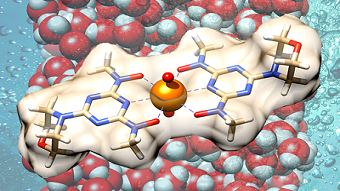 The artificial siderophore enhances the binding of uranium from seawater. Source: Alexander Ivanov/Oak Ridge National Laboratorypolymeric adsorbent material has been developed to advance the marine mining of this industrially valuable element.
The adsorbent is based on the siderophores, or iron-chelating functional groups, produced by microbes to transport iron and nutrients across cell membranes. The material formulated by researchers from U.S. Oak Ridge National Laboratory, U.S. Lawrence Berkeley National Laboratory and the University of South Florida preferentially selects water-soluble uranium. A simple synthetic procedure applied to commercially available starting materials yielded an efficient adsorbent material: 2,6-bis[hydroxy(methyl)amino]-4-morpholino-1,3,5-triazine. Preferential adsorption or uptake of uranium over competing vanadium was confirmed, with a uranyl capacity more than 100 mg/g of adsorbent without apparent inhibition by vanadium.
The polymer described in Nature Communications can be processed using mild basic solutions and recycled for extended reuse.



I'd be interested in the documentation for the claim that the oceans contain 1000 times the uranium as all the land masses. I have known about the presence of uranium in ocean water for many years, and applaud this research as a possible way to extract it. This approach probably reduces the health hazards associated with conventional mining, but makes it (in its native or unenriched isotope composition) much more available to various nations.
If the documentation for the claim is based on recent and limited water samples, the actual concentration may be skewed to falsely high readings because of the substantial usage of DU (depleted uranium) in weapons--probably thousands of tons used this way in the last 15 years. That possibility of falsely high readings can be easily checked by analysis of the isotope ratios in the samples taken and comparing them to the ratios for mined ore.