Dual function generator derives electricity from seawater
S. Himmelstein | May 20, 2019Autonomous submarine sensors, robots and other devices perform varied services, such as pipeline inspection or temperature monitoring. A reliable, independent power supply is desirable to enable these systems to function without being tethered or routinely returning to ships to replenish energy supplies. A dual-mode seawater energy harvesting system engineered by researchers in China can now provide high energy density and power density to support the operation of these underwater instruments.
The design of the energy generation scheme is inspired by the switchable energy extraction modes observed in some marine organisms: aerobic respiration for long‐term biological functions and anaerobic respiration to support high output power for fast movement. In the auto‐switchable dual‐mode seawater energy extraction 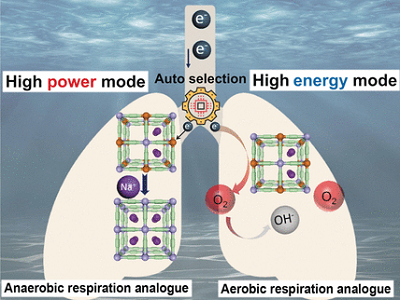 The system can switch autonomously between two modes of operation to handle short spikes of power and long-term steady power. Source: Wiley-VCHsystem, high energy density and power density are delivered by selecting different solutes in seawater as electron acceptors. One delivery mode offers slow sustained power and the other can be used for short bursts for more energy-intensive applications.
The system is based on a metal-organic framework and includes a cathode composed of Prussian blue and a metal anode. If the power demand is small, the electrons flowing into the cathode are transferred directly to dissolved oxygen. When the power demand, and thus current, are sharply increased, there is not enough oxygen at the cathode to immediately take up all incoming electrons, and the Prussian blue must store these electrons by reducing the oxidation state of the iron atoms. Positively charged sodium ions lodge within the framework until the current demand slows down and electrons are transferred to oxygen again, oxygen regenerates the framework, Fe(2+) is oxidized to Fe(3+) and the sodium ions depart.
The power generation system has a theoretical energy density of 3,960 Wh/kg and a practical power density of 100±4 mW/ cm2. The system designed by researchers from East China Normal University, Shanghai University and Chinese Research Academy of Environmental Sciences was demonstrated to operate continuously for four days in a high-energy mode without losing power.