Power management strategy boosts vehicular fuel cell durability
S. Himmelstein | May 14, 2019The promise of zero emissions fuel cell vehicles has fallen short due to range anxiety: driving range is limited 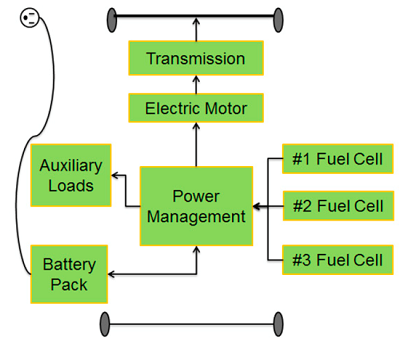 Power flows in plug-in hybrid electric vehicles with three fuel cell stacks. Source: H. Zhang et al.relative to conventional petroleum-fueled vehicles, requiring frequent stops for charging. A new fuel cell configuration and power management strategy overcomes this barrier by enhancing fuel cell durability in plug-in hybrid electric vehicles.
Each of three fuel cell stacks provides a constant, rather than fluctuating, amount of electricity under a hysteresis control strategy of power management. The scheme designed by researchers from University of Waterloo (Canada), Mälardalen University (Sweden) and Royal Institute of Technology (Sweden) evenly distributes the operation, or active, time over the fuel cell stacks so as to reduce on-off switching requirements.
Driving range is increased considerably: Durability of onboard fuel cells can be increased 11.8, 4.8 and 6.9 times, respectively, for an urban, highway and a combined urban-highway driving cycle. The improved durability can also be exploited to reduce the over-design, and the cost, of fuel cells. According to the researchers, the development could represent the next step to a a world without gasoline-fueled internal combustion engines.