Engineers downplayed cracks hours before bridge collapse
David Wagman | April 15, 2019On the day that a pedestrian bridge collapsed at Florida International University in March 2018, the project's engineers allegedly sought to ease concerns about cracking in the concrete.
In court documents that were obtained by a Miami television news station, engineers reportedly assured colleagues it was safe to keep the road below open and that temporary shoring to hold up the span was not necessary as repairs moved ahead.
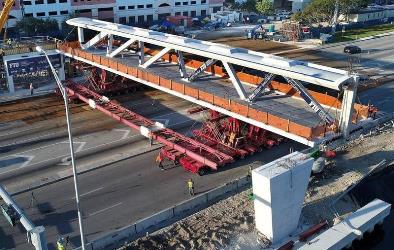 Image of the span taken during its installation in March 2018. Source: Miami Herald via KLRN The court documents are part of a handful of civil lawsuits that have been lodged related to the collapse. An investigation into the accident is being led by the National Transportation Safety Board (NTSB).
In November 2018, the NTSB said that errors in the design of the 174 ft pedestrian bridge were made, and that cracking observed before the bridge's collapse was consistent with those errors.
Six people died and eight others were injured when the bridge collapsed on March 15, 2018. Eight vehicles were crushed in the collapse, seven of which were occupied.
The NTSB stated that errors were made in the design of the northernmost nodal region of the span where two truss members were connected to the bridge deck. The design errors resulted in an overestimation of the capacity (resistance) of a critical section through the node, and an apparent underestimation of the demand (load) on that section.
The design review was conducted by the Federal Highway Administration’s Office of Bridges and Structures in support of the NTSB’s ongoing investigation. The Federal Highway Administration is a party to the NTSB’s investigation.
Span safety concerns
According to news reports in early April, lawyers stated in court briefs made reference to a two-hour meeting that was held on site the morning of March 15, 2018. According to the timeline, at 8 a.m. engineers working for the span's designer, FIGG Bridge Engineers, climbed onto the bridge deck and examined cracks that had formed and were growing on the north end of the structure.
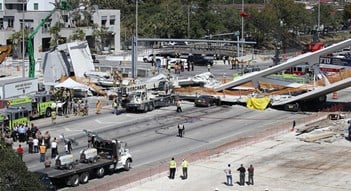 Rescue workers and investigators gather at the site following the span's collapse. Source: Miami Herald via KLRN An hour later, FIGG led a meeting about the cracks and its plan to repair the bridge. The meeting allegedly included a group of engineers from the university, the general contractor MCM, the Florida Department of Transportation and an engineering firm hired by FIU to oversee engineering and inspection.
FIGG allegedly assured the others present that its calculations confirmed "there is not any concern with the safety of the span suspended over the road." When the issue of whether temporary shoring should be brought in to reinforce the bridge during repair efforts, FIGG said it "was not necessary," the news outlet reported.
At 1:47 p.m., as a subcontractor was carrying out FIGG's orders relayed through MCM to increase tension in a truss that was cracking, 950 tons of concrete fell to the street below, killing five people in vehicles and a worker who was atop the bridge canopy.
Disputed facts
The previously sealed court pleadings were obtained by television news reporters. The court documents allegedly reveal that three days before the collapse, the project's general contractor, MCM, reported to FIGG "significant and worsening cracking of the bridge."
MCM reportedly expressed the opinion that some of the cracks were "rather large and/or of concern." It then asked if a required course of action was required to remedy or address the cracks right away.
On March 13, FIGG's president allegedly emailed the engineer of record on the project and asked, "Wouldn't it have made sense for us to address all of these things while we were on site? … I think it is important for you to stop whatever you are doing and address this so we can put all of these items to rest quickly."
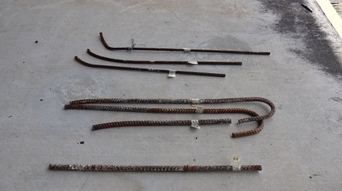 Damaged rebar taken from the accident site. Source: NTSB photo by Adrienne LammLater that day, the engineer of record informed the FDOT of the cracking and a supervisor emailed MCM, and said, "FIGG is evaluating this situation as a top priority…As of right now, we do not see this as a safety issue."
By then, FIGG's engineers had decided to order the tightening of steel bars running through the cracking truss. It was the first step of a repair method it devised to shift stresses away from the area where the diagonal truss being tightened met the bridge deck — a process that was to be implemented by about two days later, according to the minutes cited in the court filing.
At a March 15 meeting, a person from Bolton Perez & Associates, the company hired by FIU to oversee construction engineering and inspection, asked FIGG whether its repair plan had been reviewed by peers in the engineering field. Bolton Perez allegedly said it "wanted more eyes on this and the more eyes on this, the better," according to court records. FIGG apparently indicated that it had not been reviewed.
News outlets said that FIGG has challenged the accuracy of the meeting minutes. After the collapse, it provided its own version of the meeting to the National Transportation Safety Board, calling them "corrected minutes."
FIGG's version made "significant substantive changes" from the original minutes, according to a lawyer for The Louis Berger Group, an engineering firm being sued in the civil cases. The versions apparently differ over who decided it was safe to proceed with the re-tensioning of the truss while traffic flowed below; the nature and significance of the cracking, as well as who noticed it; and whether FIGG's repair plan had been reviewed by peers.