Texas DOT moves to replace FIGG as bridge designer
David Wagman | January 15, 2020The Texas Department of Transportation (DOT) on January 10 asked the chief contractor on an $800 million cable stay bridge under construction in Corpus Christi to find a new engineering firm to replace FIGG-Bridge Engineers Inc.
Design work was suspended on the Harbor Bridge in October after the National Transportation Safety Board (NTSB) cited FIGG’s role in the March 2018 bridge collapse at Florida International University that killed six people.
The NTSB findings were “significant enough,” to replace the engineering firm, news outlets quoted Texas DOT officials as saying. The NTSB report last fall concluded that “load and capacity calculation errors made by FIGG Bridge Engineers" were the probable cause of the fatal accident.
"Shocked"
News reports said that FIGG released its own statement stating it was “shocked” by the Texas transportation agency's decision to remove it from the Corpus Christi project. The firm said that faulty construction of the Florida bridge, not its design, was to blame for the collapse.
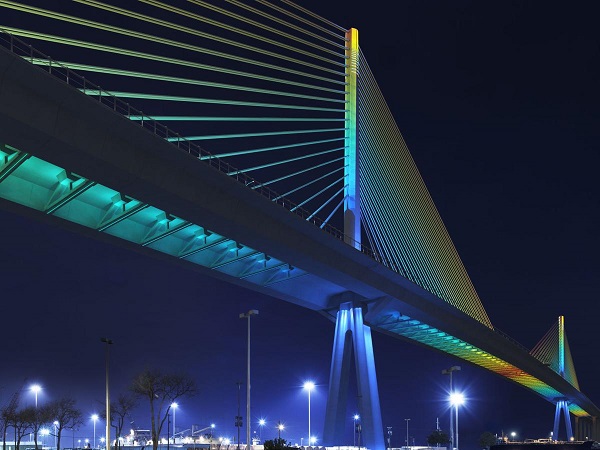 Artist's concept of the $800 million Harbor Bridge in Corpus Christi, Texas.In June, the federal Occupational Safety and Health Administration’s (OSHA’s) Office of Engineering Services (OES) said that FIGG, the Engineer of Record, failed to recognize that the bridge was in danger of collapsing when it inspected the structure hours before the failure. The OES report said that the bridge had structural design deficiencies that contributed to its collapse. The cracks occurred due to “deficient structural design,” it said.
Earlier, OSHA cited multiple contractors for safety violations related to the Florida bridge collapse. The five companies collectively received seven violations, totaling $86,658 in proposed penalties. OSHA cited FIGG Bridge Engineers Inc.; Network Engineering Services Inc. (doing business as Bolton Perez & Assoc.), a construction engineering and inspection firm; Structural Technologies LLC (doing business as Structural Technologies/VSL), specializing in post-tensioning in bridges and buildings; Munilla Construction Management LLC, a bridge and building construction company; and The Structural Group of South Florida Inc., a contractor specializing in concrete formwork.
The 950 ton bridge segment, which was under construction, fell onto a busy highway, killing six people. The 174 ft long segment had been lifted into place days before it collapsed.
Design flaw?
In a separate project also involving FIGG, work on a nearly $1 billion bridge near Houston was temporarily stopped in January so that a potential design flaw could be corrected.
The Harris County Toll Road Authority (HCTRA) said construction on the main pylons of the cable-stayed portion of the Sam Houston Tollway Ship Channel Bridge replacement project would halt for several weeks.
Last March, HCTRA hired an independent consultant — COWI North America Inc. — to conduct a complete independent review of the Ship Channel Bridge engineering design that was done by FIGG Bridge Engineers Inc.
While COWI’s full project review is expected to be complete by March 2020, the firm identified an issue related to the design of the curved portions of the pylon legs for the $962 million bridge.
Once completed, the Harbor Bridge in Corpus Christi will be one of the largest bridges of its kind in the United States. The original completion date was 2020, which was later moved to 2021. A new projected date is sometime in 2023.
Texas DOT said that related construction work will continue, mainly on drainage, roadway and overpass elements, as well as work on the interchange at Interstate 37 with U.S. 281 and Texas 286.
The project scope will include the development, design, construction and maintenance of 6.44 miles of bridge and connecting roadway. The bridge will include six-lane sections of U.S. 181, three lanes in each direction with a median barrier, shoulders and a bicycle and pedestrian shared-use path. The project also includes reconstruction of roughly 1.6 miles of I-37, reconstruction of 1 mile of the Crosstown Expressway and demolition of the existing Harbor Bridge.