
This sensor could accelerate development of hydrogen-fueled vehicles
David Wagman | April 11, 2019Researchers from Chalmers University of Technology in Sweden have developed a hydrogen sensor that they say meets future performance targets for use in hydrogen-powered vehicles.
The researchers' discovery is an optical nanosensor encapsulated in a plastic material. The sensor works based on an optical phenomenon — known as a plasmon — which occurs when metal nanoparticles are illuminated and capture visible light. The sensor changes color when the amount of hydrogen in the environment changes. The optical nanosensor used in the laboratory device contains millions of metal nanoparticles of a palladium-gold alloy. The material is known for its sponge-like ability to absorb large amounts of hydrogen.
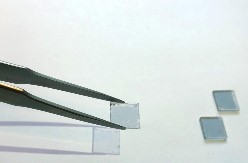 Researchers developed a fast hydrogen sensor. Source: Mia Halleröd Palmgren/Chalmers University of TechnologyHydrogen is a renewable energy carrier that can power vehicles with water as the only emission. Hydrogen gas also is highly flammable when mixed with air, so efficient and effective sensors are needed.
In the new device, plastic that surrounds the sensor is not just for protection, but acts as a key component. It increases the sensor's response time by accelerating the uptake of hydrogen gas molecules into the metal particles where they can be detected. At the same time, the plastic acts as a barrier to the environment. This prevents other molecules from entering and deactivating the sensor. Researchers said that the sensor can work both highly efficiently and undisturbed, enabling it to detect 0.1% hydrogen in the air in less than a second.
Hydrogen gas is invisible and odorless, but also is volatile and extremely flammable. It requires around 4% hydrogen in the air to produce oxyhydrogen gas, sometimes known as knallgas, which can ignite with even the smallest spark. In order for hydrogen cars and the associated infrastructure of the future to be sufficiently safe, it must be possible to detect small amounts of hydrogen in the air. The sensors need to rapidly detect leaks before a fire occurs.
The research was funded by the Swedish Foundation.




Don't know why we are so fixated on using hydrogen as a fuel source in vehicles. It is really a poor application for it. Hydrogen fuel cell technology is much better suited to long term or seasonal energy storage on the grid. Batteries belong in cars.
In reply to #1
Agree. Developments in technology such as this will have important uses, but it isn't for everyday cars and shouldn't be headlined as such. There are a few niche vehicles that suit H2 fuel cell application (drones, factory forklifts, trains?), but otherwise I too see the main applications of H2 FC's elsewhere, including in the energy storage mix.
Source: H2 Fuel cell vehicle research engineer for 2 years and Masters' thesis on airborne H2 FC applications.