Solar-assisted, corrosion-resistant seawater electrolysis system
S. Himmelstein | March 20, 2019Seawater electrolysis gets a boost as an alternative to freshwater electrolysis for hydrogen production with a solar-driven system developed by researchers from the U.S. and China.
Exploitation of seawater for hydrogen generation is seen as a preferred option to reliance on limited freshwater resources, but the presence of chloride anions poses a limitation in terms of anode corrosion. To counter this issue, the researchers designed a multilayered anode composed of a nickel foam core encased in nickel sulfide, all of which are coated with a nickel-iron hydroxide electrocatalyst layer.
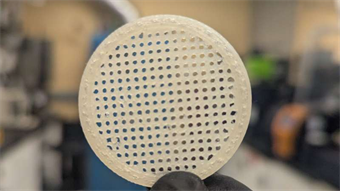
These negatively charged components repel chloride and afford corrosion resistance of the underlying metal.  The prototype generates hydrogen fuel from seawater. Source: H. Dai, Yun Kuang, Michael Kenney/Stanford UniversityThe foam functions as the conductor as the nickel-iron hydroxide promotes the separation of water into oxygen and hydrogen. Without the negatively charged layers, the anode remains functional for only about 12 hours in seawater.
A solar-powered proof of concept system using two perovskite solar cells produced hydrogen and oxygen gas from seawater collected from San Francisco Bay at 0.4 to 1 A/cm2 current densities commonly applied in freshwater electrolysis systems.
As the process also produces breathable oxygen, divers or submarines could use the technology to generate oxygen below the ocean’s surface.
Scientists from Stanford University, State Key Laboratory of Chemical Resource Engineering (China), Tianjin University of Technology (China), Shandong University of Science and Technology (China) and Beijing University of Chemical Technology (China) contributed to this study, which is published in Proceedings of the National Academy of Sciences.