
Cracking the energy storage problem with eggshells
S. Himmelstein | March 18, 2019A waste material of ornithological origins has been demonstrated to possess electrochemical properties suitable for energy storage application. The high amounts of calcium carbonate contained in chicken eggshells enable the use of this material, in powdered form, as an electrode against a metallic lithium anode in a non-aqueous 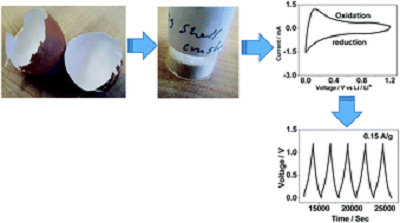 Calcium carbonate from eggshells can be used as the electrode in lithium ion capacitors. Source: M. Minakshi et al.electrolyte.
The initial discharge capacitance of the eggshell system was found to be 232 Farad/g while the reversible capacitance was 120 Farad/g. The fowl-fortified battery cell then maintained a capacity retention of 92% over the course of more than 1,000 charge/discharge cycles.
According to researchers from Murdoch University (Australia), Kyoto University (Japan), University of Wollongong (Australia) and the Helmholtz Institute Ulm for Electrochemical Energy Storage (Germany), the electrochemical performance documented is comparable to that of commercially available classical activated carbon material. The use of calcium carbonate-rich eggshells as the electrode in lithium-ion capacitors opens new avenues for sustainable energy storage through reuse of a common biowaste material.
Continued research will focus on the electrochemical and physical behavior of the material to improve its performance and enable its widespread use.




https://abc13.com/ne