
Video: Captured CO2 converted to solid carbon with liquid metal catalyst
S. Himmelstein | February 28, 2019Emissions control technologies for carbon capture and storage focus on compressing carbon dioxide into a liquid form, transporting it to a suitable site and injecting it underground. Many engineering challenges, including the risk of possible leaks from storage sites, have hampered the widespread adoption of this method. What if captured emissions could be converted back into a form approximating its origin, a coal-like solid carbon?
An international research team has engineered an efficient and scalable process that transforms the gas back into carbon at room temperature. The conversion is effected by a cerium-based liquid metal catalyst that is 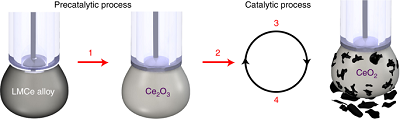 The process includes pre-catalytic reactions and the catalytic cycle for the CO2 reduction to amorphous carbon sheets. Source: D. Esrafilzadeh et al.efficient at conducting electricity while chemically activating the surface. CO2 is dissolved in a vessel loaded with electrolyte liquid and a small amount of the liquid metal, which is charged with an electrical current. Solid flakes of carbon form and detach from the liquid metal surface in a scheme that allows for the continuous production of carbonaceous solid.
To exploit the highly porous superstructure of the carbonaceous materials produced, the researchers used the material to synthesize a two-electrode capacitor as an example byproduct application. A maximum capacitance of 250 F g−1 recorded at 10 mV s−1 is comparable to some of the best performing carbon-based supercapacitors in aqueous electrolytes. Higher applied potentials yield carbon monoxide, which can be used as a precursor for a variety of industrial chemicals and synthetic fuels.
Scientists from University of New South Wales (Australia), Royal Melbourne Institute of Technology (Australia), University of Wollongong (Australia), Queensland University of Technology (Australia), Monash University (Australia), University of Münster (Germany) and North Carolina State University contributed to this research, which is published in Nature Communications.
Wake me up when this process needs less energy than you can get from burning the coal.
What a folly!
Why are they not talking about streaming the coal back into the power plant this way recycling it for its best use.
Maybe they can produce really good coking coal that way.
It's about realising practical and more useful recycling, not a perpectual motion (energy) machine. Still at "proof of concept" stage, but has promise.
You know maybe you should try to wake up somehow yourself
There can be a lot of possibilities of Improving efficiency of this process. From capturing CO2 from air or flue and also mentioned catalystic conversion can be also probably improved .... so wake up and observe, search, (do not forget stop searching as a process of searching), pay attention ... :)