Building better, cheaper perovskite-based flexible solar cells
Peter Brown | February 13, 2019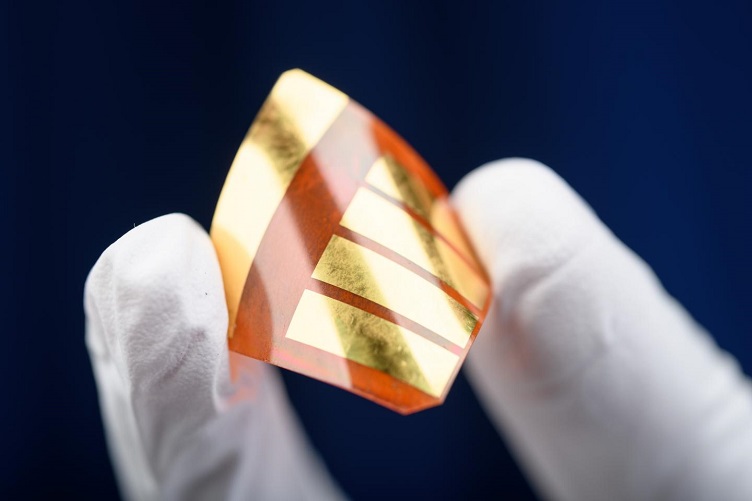 Flexible solar cells could get a performance boost with perovskite technology. Source: University of Georgia
Perovskite-based solar cells hold promise to change the approach to delivering green energy over traditional silicon-based cells because they are simple and cheap to produce yet flexible enough to cover a wide range of installation methods.
The trouble with these perovskite solar cells is developing them to last longer than a couple of months.
Researchers at the Georgia Institute of Technology, University of California at San Diego and MIT have developed a path toward perovskite solar cells that perform better.
"Perovskite solar cells offer a lot of potential advantages because they are extremely lightweight and can be made with flexible plastic substrates," said Juan-Pablo Correa-Baena, an assistant professor in the Georgia Tech School of Materials Science and Engineering. "To be able to compete in the marketplace with silicon-based solar cells, however, they need to be more efficient."
Researchers found that adding alkali metals to the traditional perovskites lead to better performance.
The method includes adding cesium and rubidium to the mixed bromine and iodine lead perovskite mixture causing the bromine and iodine mix to work together more homogenously. The result was up to 2% higher conversion efficiency than the materials without these additives.
"We found that uniformity in the chemistry and structure is what helps a perovskite solar cell operate at its fullest potential," said David Fenning, a professor of nanoengineering at the University of California San Diego. "Any heterogeneity in that backbone is like a weak link in the chain."
However, the combination of metals created inactive dead zones in the solar cell that produce no current. While in traditional solar cells this would typically kill the cell, in perovskites the dead zones weren’t too detrimental to solar cell performance, even though there was some current loss.
Researchers said that this shows that while performance upgrades are possible, there is more room for improvement.
The full research can be found in the journal Science.