Grid stabilization by use of automobile battery storage
S. Himmelstein | February 12, 2019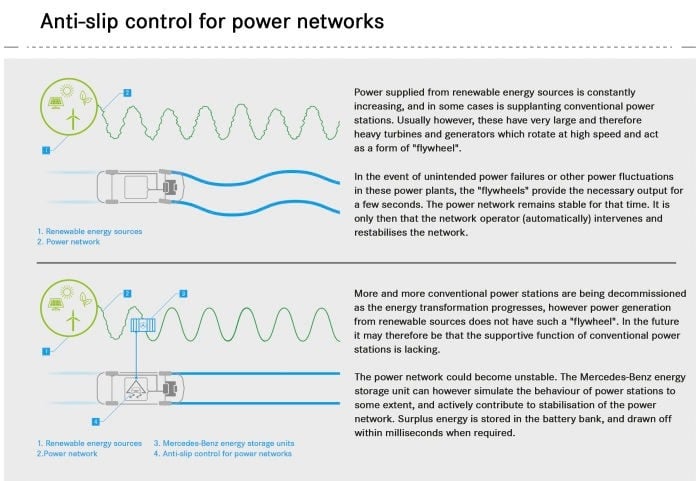 Source: Daimler AG
Used automobile battery storage systems can find a second life by being pressed into service to start up energy generating assets, including entire power stations, and improve power grid stability. Research conducted by German transmission system operator TenneT and Daimler AG confirmed the utility of lithium-ion batteries for dynamic system support to help offset loss of conventional energy generation.
Increased penetration of electricity from intermittent renewable energy sources also increases grid volatility. An imbalance between power supply and demand results prevents maintenance of the 50 Hz transmission frequency as required in Germany.
A prototype automotive battery storage system was demonstrated to respond to changing frequencies in under 100 milliseconds. The system composed of second-life and replacement batteries was operated in a test grid with a total connected load of approximately 1 MW and a storage capacity of 750 kWh. Power was restored after a simulated power failure, proving that the batteries could provide energy sufficient for system restart.
Currently, diesel power units are used to restart power station turbines and to supply power to auxiliary units. The battery storage systems can also be implemented for these applications with virtually no losses.
Another demonstration of advanced battery storage based on new and used electric vehicle batteries is now underway by Groupe Renault at three sites in France and Germany. The system will have a storage capacity of at least 60 MWh, making it the largest of its kind to be built in Europe.