A modeling method to optimize mitral valve repair
S. Himmelstein | February 01, 2019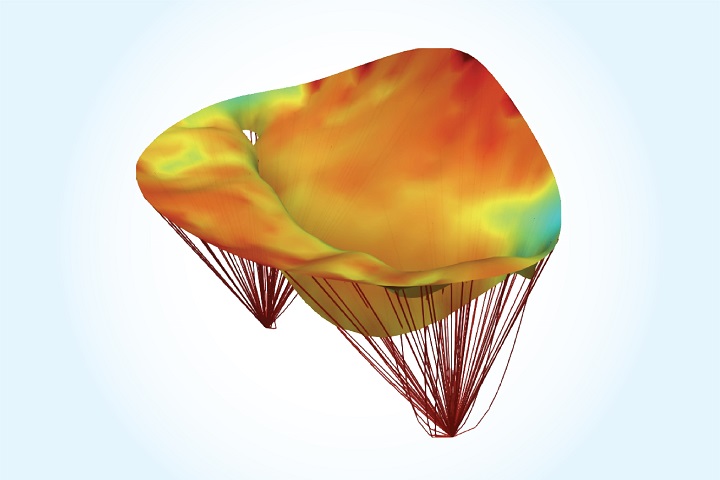 A computational model of the mitral valve pre-surgery. Source: Cockrell School of Engineering, University of Texas at Austin
Mitral valve (MV) repairs are complex surgeries that require particular attention to each patient’s unique anatomy. But a lack of accurate, non-invasive methods to pinpoint MV leaflet deformation usually results in a one-size-fits-all surgical solution. Up to 60% of patients who have undergone MV regurgitation surgery report recurrence just two years after the procedure, indicating room for significant improvement.
A computational model devised by the University of Texas at Austin, Georgia Institute of Technology and University of Pennsylvania researchers simulates leaflet geometry with sufficient accuracy to improve surgical outcomes. The approach produces functionally equivalent MV models that can be built from the image-based MV leaflet geometry alone. It also includes structural and mechanical properties relevant to the closed and open states of the valves, enabling users to map optimal repair strategies for individual patients.
The researchers demonstrated that the model accurately replicated the closing behavior of MVs under normal, diseased and surgically repaired scenarios. They plan to commercialize the simulation technique, which can also be used for model validation and for studies of MV disease and repair.