
Report: Environmental implications of SST flight reintroduction
S. Himmelstein | February 01, 2019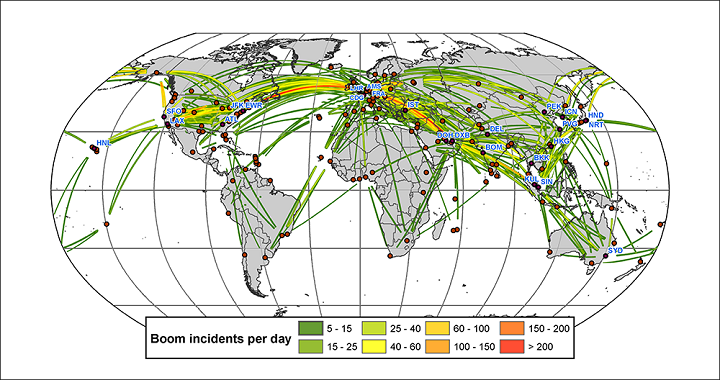 Projected global incidence of sonic booms. Source: ICCT
Three U.S.-based startups are working to develop new supersonic transport (SST) aircraft, including a 55-seat commercial jet. Since 2016, advocates of supersonic flight have pushed to lift existing bans on overland flight in the U.S. despite the objections of environmental and public health groups.
Reintroducing commercial SST aircraft into the global aviation fleet could have significant noise and climate impacts by 2035, according to a new study by the International Council on Clean Transportation (ICCT). Researchers evaluated the landing and takeoff noise, sonic boom and carbon dioxide emissions from a new, unconstrained SST network of 2,000 in 2035. This fleet is projected to support approximately 5,000 flights per day at 160 airports worldwide.
About 87% of flights are expected to be international, with about one third being transoceanic, and the aircraft could double the area around airports exposed to substantial noise pollution compared to existing subsonic aircraft of the same size.
Frequent sonic booms would occur in Canada, Germany, Iraq, Ireland, Romania, Turkey and parts of the U.S. The more heavily impacted regions could be exposed to 150 to 200 incidents per day, or up to one boom every five minutes over a 16-hour flight day.
An estimated 96 million metric tons of CO2 would be emitted by this fleet annually, roughly equivalent to the combined emissions of American, Delta and Southwest Airlines in 2017. An additional 1.6 to 2.4 gigatons of CO2 are projected to be released over the 25-year lifetime of SST aircraft. That would consume about one-fifth of the entire carbon budget afforded international aviation under a 1.5° C climate trajectory, assuming that aviation maintains its current share of emissions.
Remedies recommended for regulators include implementing new SST standards that would allow those aircraft to produce more noise and air pollution than new subsonic designs, or applying existing subsonic standards to SSTs.



I'm sure we can expect an objective evaluation by the International Council on Clean Transportation (ICCT).
I seriously doubt there will be a market that supports 5,000 supersonic flights per day as the ticket prices will certainly be breathtaking.
Simplistically, with the advent of the Internet, Teleconferencing, etc., what's the need for so many people, to fly so often, so fast, when exclusively executive flights could be made more luxurious for a lot less money, in a lot less environmentally impactful way...