Four NASA tactics to mitigate communications system obsolescence
Eric Olson | January 25, 2019Obsolescence hit the major ground-based portion of the Space Network communications system that space agency NASA relies on to track orbiting spacecraft and transfer data to the ground. The relay system is considered to be mission critical and must operate with near-perfect uptime.
Technology obsolescence is a challenge faced by many design engineers. Critical components may no longer be supported by vendors, some of which may no longer be in business. Mission-critical functions--many at least as vital as spacecraft-to-Earth data exchange--can be put into jeopardy as a result.
For NASA, the last major update to the ground segment’s systems occurred in 1996. Over the years, much of the original hardware and software has become obsolete and many of its components are no longer supported by vendors. A lack of spare parts puts the network at risk of a breakdown if components fail. Outdated hardware and communication protocols are insufficient to support future missions.
Hindered by the Ground Segment’s aging technology, NASA embarked on a campaign to refresh the system. The agency’s Space Network Ground Segment Sustainment (SGSS) project will modernize the network’s ground infrastructure to support space missions for at least 25 more years.
 SGSS will fit more functionality into 1.5 racks of equipment than the 24 racks of modems and beamformers in the current system. Source: NASA (Click image to enlarge.)
The project, however, is no easy task. The ground segment's complex network of systems includes multiple interconnected elements in space and on the ground that depend on each other for a variety of functions. Among the systems are a signal distribution and processing system, time and frequency system, control system and other computing equipment. The complex and interconnected nature of the communications system has been a formidable barrier standing in the way of a quick and simple overhaul to bring it up to modern standards.
The complexity has resulted in delays and cost overruns for SGSS. The project began with an initial contract awarded to General Dynamics in June 2010 of $626.2 million. According to a Government Accountability Office report in May 2018, the project’s total cost has grown to $1.32 billion. The project is expected to be operationally ready in September 2019, with a final acceptance review scheduled for June 2021.
At least four lessons about how to deal with and mitigate technology obsolescence can be learned from NASA’s efforts to overhaul its Ground Segment’s signal processing system.
1. Replace analog signal processing chains with a digital fabric
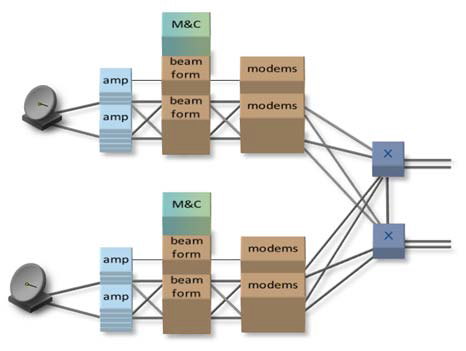 The ground segment’s current signal processing chain consists of strings of analog equipment dedicated to single antennas. Source: NASA
The existing ground segment signal distribution architecture, dating back to the 1980s, is largely analog. Radio frequency (RF) signals from tracking and data relay (TDR) satellites arriving at ground terminal antennas are transferred through strings of fixed equipment, including amplifiers, beamformers and modems. The analog architecture has a major downside: Each string is assigned exclusively to a single TDR satellite, with no means of directing equipment to handle the workloads of other satellites as needed.
SGSS replaces the analog signal processing chain with a digital signal distribution system. This change enables signal processing equipment to be pooled for flexible allocation of resources. Equipment can be assigned as needed to process signals traveling between the ground segment and satellites and among ground terminals.
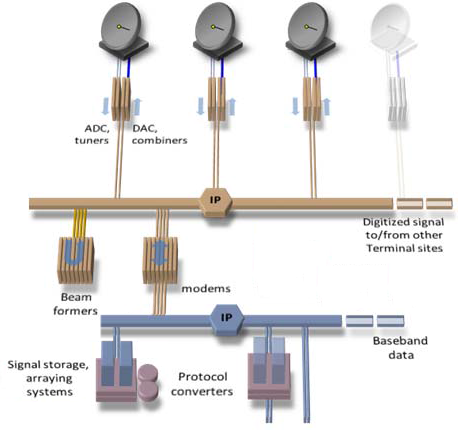 With SGSS, satellite signals are digitized upon reception and delivered to a pool of digital hardware for processing and distribution. Source: NASA
The new architecture utilizes analog-to-digital converters to convert satellite signals received at ground antennas directly to digital intermediate frequency (IF) data carried in internet protocol (IP) packets. This data stream spans the two ground terminals at the Space Network’s White Sands Complex in New Mexico, so beamformers and modems from any site can process the data, demodulating and decoding digital IF data for distribution over Ethernet baseband to end users.
[Discover RF frequency downconverters on Engineering360.]
There are a number of benefits to digitizing downlink signals upon reception at the ground antennas and delaying conversion of uplink signals to analog until just before transmission to satellites. Unlike analog signals subject to degradation over long distribution distances, digital signals are nearly "lossless." Digital signals can also be handled by widely available, open-standard equipment instead of costly, proprietary analog components like waveguides and switches.
2. Maximize the use of commercial off-the-shelf products
In overhauling the ground segment’s analog digital processing system with a digital fabric, NASA and prime contractor General Dynamics took a long-term view. To meet the system’s minimum 25-year lifetime requirement, designers focused on minimizing long-term sustainability risks. A key design principle was to select hardware and software platforms based on open standards with wide industry adoption, and to avoid custom and proprietary designs and components.
 SGSS achieves satellite telemetry, tracking and control with GMV’s Hifly COTS software, providing a standard interface for satellite operations which can be customized for the specific requirements of the Space Network. Source: GMV
With this design philosophy in mind, engineers sought to maximize the use of commercial off-the-shelf (COTS) components to keep costs under control and prevent reliance on a single vendor that might go out of business. Given the unique mission requirements of the Space Network, however, some customization was inevitable.
For example, COTS software needed custom code alterations to successfully integrate with ground systems and perform special processes, such as verification procedures for command uploads that demand closely coupled command formats and telemetry processing. As a result, COTS software with adaptation points and external APIs were chosen to allow the addition of custom code and the exchange of data with SGSS systems. An example is GMV’s Hifly telemetry, tracking and control software, a packaged solution with the ability to adapt to the specific needs of a project.
3. Select network and transport protocols with widespread adoption
 New SGSS equipment is deployed inside an antenna hub at the White Sands Complex in New Mexico. Source: NASA
In choosing network and transport layer technologies for SGSS, engineers attempted to maximize sustainability, performance and reliability while minimizing cost and implementation risk. At the physical and data link layer, 10 gigabit Ethernet (10 GbE) was selected over 40 GbE and 100 GbE due to its maturity, wide adoption and extensive hardware options. Infiniband was ruled out due to its uncertain future and risk of becoming a niche protocol.
[Discover ethernet switches on Engineering360.]
At the network layer, IP was chosen for its ubiquity. Transmission Control Protocol’s (TCP's) structured orderliness and reliability proved too slow for the system’s requirements, resulting in the selection of User Datagram Protocol (UDP) instead for its speed and low latency. Multicast distribution using Internet Group Management Protocol (IGMP) was chosen instead of unicast for the flexibility of delivering data from a single source to multiple subscribers simultaneously, such as modems, beamformers and data recorders.
Finally, at the highest layer in the stack, Vita Radio Transport (VRT) was selected as the encapsulation protocol instead of Signal Data Distribution Standard (SDDS) due to the likelihood of VRT gaining more widespread adoption and support in the coming years.
4. Choose extensible and standards-based hardware architectures
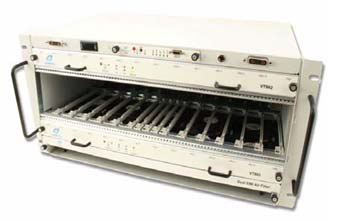 A MicroTCA chassis. The open-standard MicroTCA specification defines the hardware architecture for much of SGSS’s digital signal processing system. Source: NASA
The hardware architecture chosen for SGSS is based on standard interfaces and form factors. A single field programmable gate array (FPGA) framework was chosen so that FPGA intellectual property cores could be reused in multiple signal processing functions. A standard card form factor, FPGA advanced mezzanine cards (FMC), allows a single board to be used for many functions, including modems and beamformers, analog-to-digital downconverters/tuners, digital-to-analog upconverters/combiners and user serial interfaces. FMC cards plug into MicroTCA chassis, providing redundant, high-speed backplane connectivity.
Standards-based hardware architecture not only simplifies maintenance but also facilitates future system enhancements. These improvements include adding new hardware with faster or more advanced processing capabilities or uploading new firmware to improve processing algorithms.
Extensibility is a core principle of SGSS, with the capability to expand designed into the system from the start. The high-speed Ethernet switches selected to transmit digital IF traffic have several empty slots in which interface cards with additional ports can be installed to increase the number of TDRS satellites the system can support.
 A new radial combiner and solid-state amplifiers are installed in an antenna shelter at the White Sands Complex. Source: NASA
SGSS will also replace the old, bulky traveling wave tube amplifiers (TWTAs) used to boost signals before transmission to satellites with compact solid-state power amplifiers (SSPAs). This will eliminate the need to replace increasingly rare TWTA vacuum tubes and allow hot swaps with no disruption to satellite uplinks.
[Discover solid state amplifier products on Engineering360.]
Take the long view
NASA decided to tackle obsolescence head-on with SGSS, embarking on an ambitious undertaking to modernize the ground portion of its Space Network. In their efforts to overhaul the ground segment’s outdated infrastructure, the project’s engineers took a long-term view, emphasizing design principles that would mitigate future obsolescence.
They also focused on enhancing the system’s performance, flexibility and availability to improve operations; increasing longevity and maintainability to reduce future sustainment costs; and boosting extensibility and scalability to make it easier to expand and introduce new capabilities.
With SGSS, NASA intends to lay the groundwork for its Space Network to support space mission telecommunications for decades to come.
Further reading
NASA’s Space Network Ground Segment Sustainment Project Preparing for the Future