Dietary choices for improved environmental sustainability
S. Himmelstein | January 10, 2019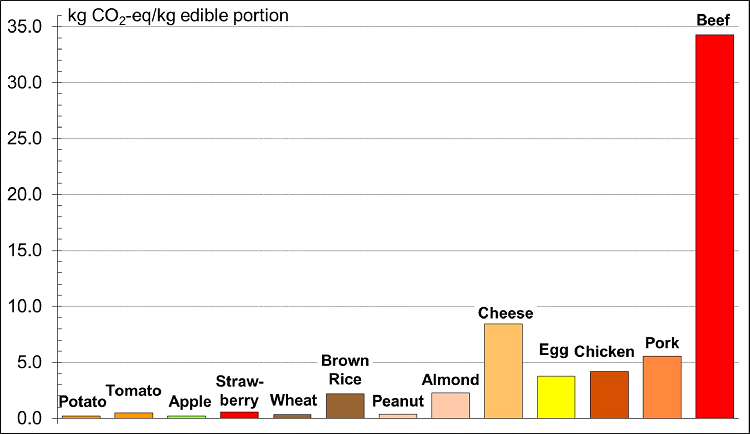 Greenhouse gas emissions for the production of selected foods (kilograms of carbon dioxide equivalents per kilogram of edible portion of commodity). Source: Martin Heller et al., University of Michigan
It is commonly accepted that power plant emissions, industrial wastewater discharges and vehicular emissions adversely impact the environment. Biodiversity loss, accelerated climate change and ecological degradation are some of the end results associated with environmental inputs from the modern conveniences of a stable power supply, manufacturing and transportation.
Agricultural practices also contribute to these problems, which is why the Society for Nutrition Education and Behavior proposes that federal dietary guidelines should include environmental sustainability considerations and a greater emphasis on plant-based dietary choices. Life cycle assessments show that environmental impacts from food production are higher for animal products and higher still for ruminant animals. For vegetables and fruits, carbon dioxide-equivalent (CO2-eq) values are typically less than 1 kg CO2-eq/kg of commodity while beef has a value greater than 30.
Organic agriculture can also be an agent of non-sustainable food production: the greater areas of land required for these operations translate into greater contributions to climate change. Without the use of agrichemicals, yields per hectare are reduced compared with conventional farming. The need for larger land areas to maintain a desired yield level comes at a cost in terms of deforestation and other land uses that undermine ecological carbon storage capacity.
Food transportation and distribution studies indicate that reducing meat consumption, particularly of ruminant animals, has a greater impact on lowering greenhouse gas emissions than does reducing the imports of produce from air shipping. Data indicate that a dietary shift away from red meat and dairy could result in a greater reduction in these emissions than buying all foods locally.
Food loss is a growing problem, particularly in the U.S., and incurs all of the environmental impacts of food that is consumed, as well as additional impacts from the disposal process with none of the benefit for human nutrition. Research into food choices suggests that replacing beef with plant-based options could have substantial positive impacts on the environment, including a significant reduction in greenhouse gas emissions and land use while offering an improved intake of many important nutrients.
The evidence points to the role of current food choices and agricultural practices in exacerbating environmental problems. The inclusion of environmental sustainability considerations in federal dietary guidelines is advocated, and educators are urged to convey both the health and environmental benefits of dietary choices.
Researchers from Tulane University, the University of Michigan and the University of Pennsylvania contributed to the policy statement from the Society for Nutrition Education and Behavior, which is published in the Journal of Nutrition Education and Behavior.