These Projects Could Halt the GOM's Production Decline
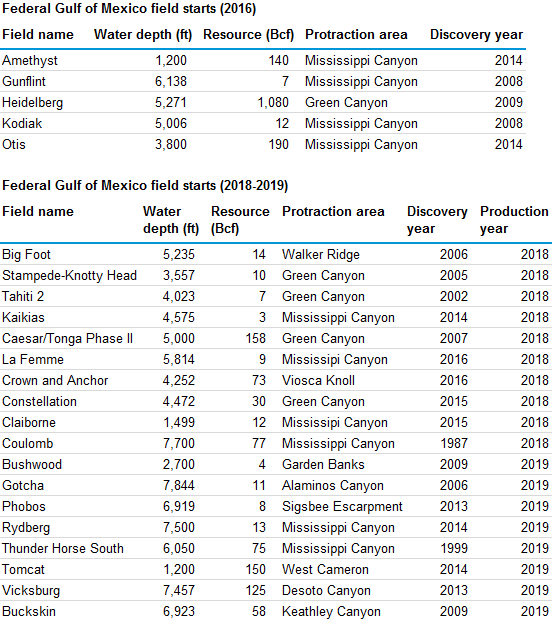
David Wagman | November 26, 2018Natural gas production in the U.S. Federal Gulf of Mexico that has been declining for nearly two decades may be reversed as 10 new natural gas production fields are expected to start producing in 2018.
 Another eight are expected to start producing in 2019, according to information reported to the U.S. Department of Interior’s Bureau of Safety and Environmental Enforcement and analyzed by the Energy Department's Energy Information Administration (EIA).
The projects starting in 2018 and 2019 have a combined natural gas resource estimate of about 836 billion cubic feet.
 Source: EIAMarketed natural gas production in the Gulf of Mexico (GOM) averaged 2.6 billion cubic feet per day (Bcf/d) through August 2018, accounting for 4% of total U.S. production, the EIA said. In 1997, when the EIA began collecting GOM production data, production averaged 14.3 Bcf/d, accounting for 26% of the United States’ total annual marketed natural gas production.
The number of natural gas producing wells in the GOM fell from 3,271 in 2001 to 875 in 2017. The technology and expertise required to produce oil and natural gas from the seabed is expensive and specialized, the EIA said, and costs of production platforms can often exceed $1 billion. With the growth in exploration and production activities in shale gas and tight oil formations, onshore drilling became more economic relative to offshore drilling.
Most of the natural gas produced in the GOM is characterized as "associated-dissolved" natural gas that is produced from oil fields. Although older oil wells in the GOM tend to have higher natural gas content, newer wells are more oil-rich, resulting in less natural gas per well. According to the EIA’s Natural Gas Annual, 59% of gross withdrawals of natural gas in the GOM were from oil wells in 2017, up from 13% in 1997.
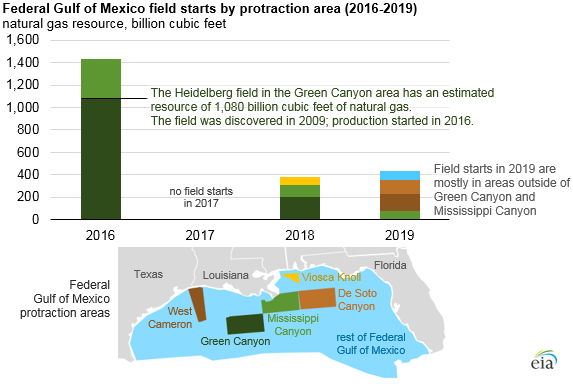 Source: EIATwelve of the new projects are located in the Mississippi Canyon and Green Canyon protraction areas. The others are in the western GOM planning area (such as West Cameron) or the eastern GOM planning area (such as De Soto Canyon or Viosca Knoll, among others).
Onshore Growth
Nationally, natural gas production rose by more than 10% since 2017, driven largely by the Appalachian Basin in the Northeast, the Permian Basin in western Texas and New Mexico, and the Haynesville Shale in Texas and Louisiana.
According to the EIA, these three regions made up less than 15% of total U.S. natural gas production as recently as 2007. As of last summer, they accounted for nearly 50% of total production.
New drilling and completion techniques have largely driven growth in the three regions, EIA said. Techniques include longer well laterals that have increased well productivity.
Natural gas production growth in the Northeast has come mainly from the Marcellus and Utica shale plays in the Appalachian Basin. Recent infrastructure build-out in the region has allowed natural gas to move out of the region and has reduced the discount to the national benchmark price at Oklahoma's Henry Hub and to regional prices.