
Power Sector's Water Use Fell in 2017
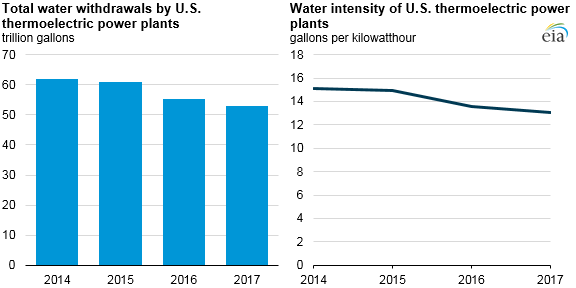
David Wagman | November 09, 2018Water withdrawals by U.S. thermoelectric power plants was 52.8 trillion gallons in 2017, continuing a decline in volume since 2014.
The power generation sector's water intensity — namely, the average amount of water withdrawn per unit of total net electricity generated — fell from 15.1 gallons per kilowatt hour (kWh) in 2014 to 13.0 gallons per kWh in 2017. The findings were reported by the Energy Department's Energy Information Administration (EIA).
 Lake used for cooling at Duke Energy's Harris nuclear station. Source: Duke EnergyThermoelectric power plants pull water from sources such as rivers or lakes to cool equipment used to generate electricity. After withdrawal, the water is either consumed, meaning it is lost to evaporation or blowdown during generation, or it is returned to a body of water. According to the U.S. Geological Survey, electric power generators are the largest source of U.S. water withdrawals and account for about 40% of total U.S. water withdrawals.
(Read the Engineering360 series of articles on the fundamentals of cooling tower heat transfer.)
The decline in water withdrawals largely has been driven by changes in the electricity generation mix, the EIA said. Between 2014 and 2017, the share of U.S. electricity generation from coal-fueled sources fell from 39% to 30%. The natural gas share rose from 27% to 32%, and nonhydro renewables increased from 7% to 10%.
 Source: EIAElectricity generation from renewable resources such as wind and solar requires almost no water, the EIA said. And combined-cycle natural gas power plants, which account for much of the natural gas-fired generating capacity added in the past two decades, require less water on average than a coal-fired power plant.
In the eastern U.S., where sources of water are more readily available, so-called once-through cooling systems are more prevalent. Once-through cooling systems withdraw large amounts of water to cool the power plant, and they do not reuse water the way that recirculating cooling systems do. As a result, power plants in the eastern U.S. withdraw more water per unit of electricity generated than those in the west.
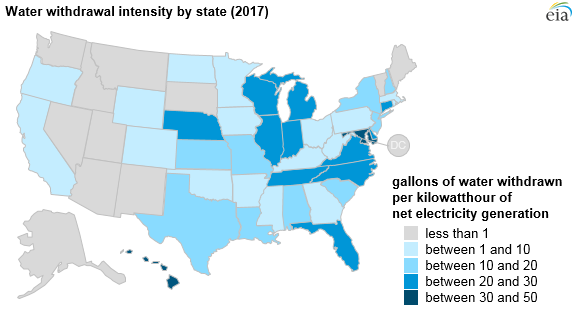 Source: EIABecause water is scarcer in some western regions, many power plants in western states are fitted with recirculation, dry cooling or hybrid cooling systems, which require less water for cooling.
For example, the EIA said that in 2017, Maryland’s water intensity was 47 gallons per kWh, the highest in the country. Nearly 90% of the state’s electricity was generated from thermoelectric power plants, of which 65% was accounted for by units equipped with once-through cooling systems.
Utah and Arizona have a similar electricity generation mix as Maryland. However, because their thermoelectric power plants are equipped with recirculating cooling systems with cooling towers, the water intensity in those states was less than half a gallon per kilowatt hour.




It amazes me that instead of having these vast cooling towers that the water couldn't be piped to a town and used to heat houses & businesses as well as going through heat exchangers for hot water, instead all that energy is pumped into the atmosphere, what a waste.
Bazzer
Ever been to former East Germany?