Cheez-It Toting Drone Tests Last Mile Energy Use
David Wagman | November 07, 2018A scientist who is leading a research effort to quantify how much energy drones eat up when delivering packages is using his favorite snack food as cargo.
Victor Walker is a researcher at the Idaho National Laboratory, which is the Department of Energy's (DOE's) designated lab for unmanned aerial vehicle (UAV) research and testing.
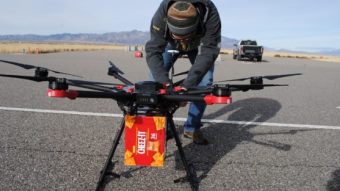 Researchers used 5- , 10- and 15-pound packages of snack food to test drone delivery performance. Source: Idaho National LaboratoryThe drone study is part of the DOE’s Energy Efficient Mobility Systems (EEMS) project, a larger effort to understand the energy impacts of new mobility technologies. Within the EEMS project, the SMART Mobility Laboratory Consortium is a multi-laboratory collaborative that analyzes freight delivery technologies with an emphasis on the first and last mile of package delivery.
Last Mile Delivery
Because many drones come with some degree of automation, one potential use for them is so-called “last mile delivery,” where a delivery driver sends a drone with a package in one direction, while he or she goes another direction in the vehicle.
Walker apparently favors Cheez-It snacks, and reportedly has a reputation around the lab for his collection of empty boxes, many featuring special edition themes or discontinued flavors. So when it came time for Walker to test how drones delivered packages under various conditions, he did not need much time to chew over the options.
Walker and his team set up experiments using DJI Matrice 600 Pro Hexacopters, 22-pound drones with six rotors that can take off with up to 15 pounds of cargo and fly at a top speed of 40 miles per hour.
During the tests, the researchers measured multiple parameters of drone energy use, including how much energy the batteries used and how much energy each motor consumed during the flights. The team then measured how well the drones performed under certain scenarios.
Food for Thought
Walker sent drones carrying no packages, and drones carrying 5-, 10- and 15-pound packages of Cheez-Its 50 and 100 feet into the air. The UAVs were tested as they hovered and also as they traversed a one-mile route at either 17 or 30 miles per hour.
Once the data was digested, the team learned that drones take a significant amount of energy to fly, especially when carrying packages. For example, a drone eats up about the same amount of energy to deliver a single package one mile as an electric car (which could hold several packages) needs to drive the same distance.
They also confirmed that any time the drone spent hovering also wore down the device's batteries. But the team also found that the faster a drone flies, the less energy it uses, simply because it spends less time in the air.
UPS reportedly has expressed interest in Walker’s work, and more companies could follow. No word, however, on whether Kellogg NA, which produces Cheez-Its, will cater future tests.