App Could Help OCD Patients Control Their Symptoms and Impulses
Siobhan Treacy | October 23, 2018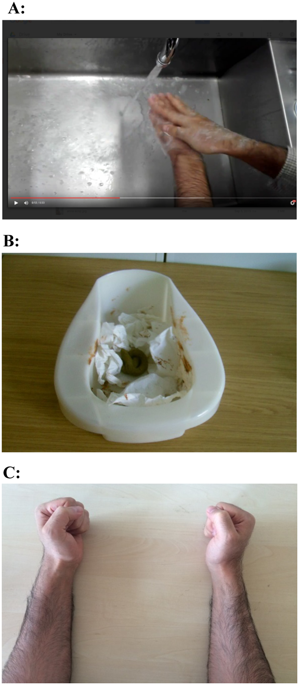 (A) The video footage used in the “washing” group. (B) The “disgust stimulus” used for the video footage in the “contamination” group. (C) The hand movements performed for the video footage used in the control condition. Source: University of Cambridge
A new app has been developed at the University of Cambridge to help OCD patients control their symptoms with just a smartphone.
The most common OCD symptoms are excessive washing and contamination fears, with 46% of OCD patients reporting these symptoms. OCD is commonly treated with medication or a form of cognitive therapy. Patients are tasked with touching dirty surfaces daily, without washing. Forty percent of the patients who use this kind of therapy report no positive response to these treatments. The treatment failure could be due to years of suffering or the patients skipping treatment because they find it too stressful.
The smartphone app delivers cognitive therapy treatments via videos. Patients watch videos of themselves either washing hands or touching fake dirty surfaces.
A study that tested the app included 93 participants who were healthy with strong contamination fears. The researchers didn’t use OCD patients because they didn’t want to make their symptoms worse, which was a risk of the study. All 93 participants scored high on the Padua Inventory Contamination Fear Subscale, a commonly used scale to test patients for OCD symptoms.
The participants were split into three groups. Group one watched videos of themselves washing their hands. Group two watched videos of themselves touching fake contaminated surfaces. Group three acted as the control group, watching videos of themselves making neutral hand movements.
All the groups spent one week watching 30-second videos four times a day. Groups one and two showed improvements and reduced OCD symptoms at the end of the day. They also tested with greater cognitive flexibility when compared to group three. The Yale-Brown Obsessive Compulsive Scale scores of groups one and two improved by 21% at the end of the week. All of the participants completed a full week of treatments, with an average watch score of 25 out of 48 videos.
Baland Jalal, from the Department of Psychiatry at Cambridge, said, "Participants told us that the smartphone washing app allowed them to easily engage in their daily activities. For example, one participant said 'if I am commuting on the bus and touch something contaminated and can't wash my hands for the next two hours, the app would be a sufficient substitute'."
Professor Sahakian, also from the Department of Psychiatry at Cambridge, said, "This technology will allow people to gain help at any time within the environment where they live or work, rather than having to wait for appointments. The use of smartphone videos allows the treatment to be personalised to the individual. These results while very exciting and encouraging, require further research, examining the use of these smartphone interventions in people with a diagnosis of OCD."
The researchers say that more testing needs to be done before the app can become available to the public.
The paper on the new app was published in Scientific Reports.