Jeddah Tower - Building a Skyscraper on Sand
Roger Pink | May 10, 2018With a population of 5.1 million, Jeddah is the second largest city in Saudi Arabia. Located on the Red Sea, Jeddah serves as a port for Muslims arriving by sea for the Hajj, the annual Islamic pilgrimage to Mecca. As host to these pilgrims, Saudi Arabia wishes to create a lasting image of the country for its guests to take home with them. It is for this reason that Prince Al-Waleed bin Talal bin Abdulaziz al Saud, founder and CEO of the Kingdom Holding Company, chose Jeddah to build the tallest building in the world. If all goes as planned, by 2020 pilgrims entering the city will witness a modern marvel, a skyscraper more than 1 km in height called the Jeddah Tower.
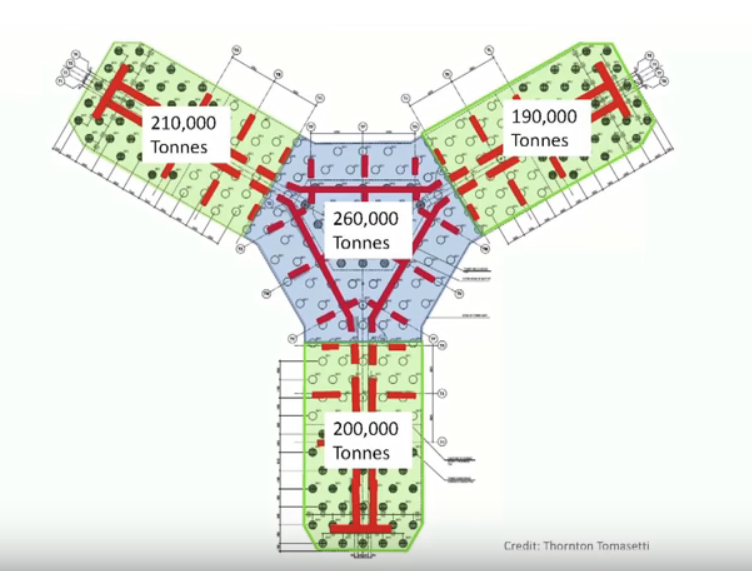 Jeddah Tower will have three wings to help stabilize wind load.
The Jeddah Tower will not stand alone. It will be the centerpiece of a 5.2 square km plot 20 km north of Jeddah, called Jeddah Economic City. This ultramodern district with an estimated cost of $20 billion will feature both commercial and residential development, including homes, hotels and offices. Jeddah Tower is being constructed first, with a price tag of $1.2 - 1.5 billion. Designed in a three wing style similar to the other recent mega-skyscrapers, its designers have called it the Burj Kalifa (Dubai) taken to its natural conclusion. Although originally designed to be over a mile high, it has since been reduced in height to over one kilometer. The builders will not reveal the exact height until after construction is completed.
At first glance, a $20 billion development project featuring the world’s tallest building might seem superfluous. However, Saudi Arabia is in the midst of a cycle of high population growth and short housing supply. An estimated 900 new homes a day are needed to meet the growing demand of a population that has quadrupled in the past four decades. Currently, Saudi Arabia is heavily reliant upon oil revenues but is looking to diversify its economy by improving infrastructure and exploring other industries. Along with Jeddah Economic City, a new airport and other infrastructure are being built in the area to replace the current existing crumbling infrastructure.
Located on the Red Sea, the development of the Jeddah Tower has been a challenge from day one. In order to build a stable building to such a massive height, a deep understanding of the subsurface is needed. At the site of the Jeddah Tower, there exist five distinct subsurface layers. The first layer, varying from half a meter to 2 meters thick consists of silty sand. The next 40 to 50 meters is coralline limestone, followed by a 2 to 10-meter thick mudstone/gravel layer. Next comes a poorly constituted sandstone layer about 35 to 50 meters thick, followed by another 3 to 9-meter gravel layer. Finally, below all of this is a sandstone layer as far as 200 meters.
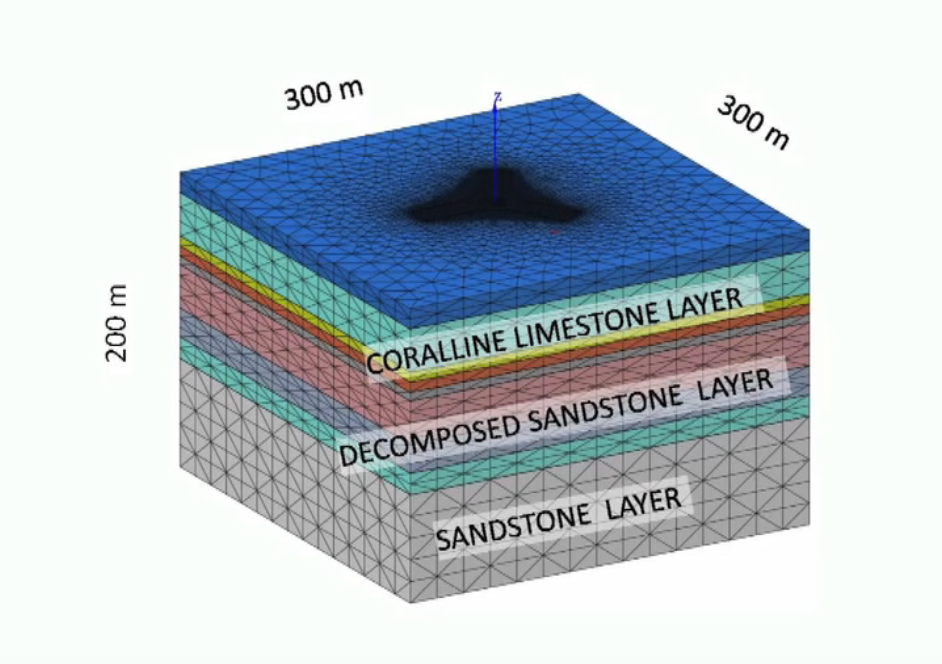 The subsurface beneath the foundation of Jeddah Tower. Source: Geo-Institute of ASCE
The foundation will have to handle a gravity load in excess of 860,000 tons at a pressure of 2.65 Mpa. The design calls for 270 1.5 and 1.8-meter diameter piles with a differential settlement goal of 25 mm. This foundation will support a bearing wall tower to about 670 meters where it transitions into a closed silo spire. The tower will be very slender, with a height to width aspect ratio of 12:1. The Willis (formerly Sears) Tower, for reference, is 7.5:1.
The large number of piles is a direct result of the softness of the coral limestone layer and a reluctance to try to pass through the mudstone/gravel layer. The coral limestone has a specific gravity of 1.8, which makes it comparable to medium-dense sand which obviously not ideal. The region around Jeddah is not particularly seismically active, however, so the original design called for a large number of piles that were contained within that coral limestone layer. Unfortunately, when settling was taken into account this was deemed insufficient and longer piles, some as long as 105 meters, were added to the design. The added length to some of the piles is sufficient to get the tower models to within design parameters.
When completed the Jeddah Tower will be a mixed-use building, with most of the bottom floors being reserved for offices, hotels, and service apartments. The majority of the usable building will consist of residential apartments. Above that will be exclusive executive suites. Finally, above the executive suites will sit the penthouse, which has already been purchased by Prince Al-Waleed bin Talal bin Abdulaziz al Saud. The spire will not be a livable space. Towering over the Jeddah Economic City, it will be a monument to man’s ingenuity along the pilgrim’s path to Mecca. For Saudi Arabia, it will be a symbol of hope for a prosperous future.