With Nuke Licenses in Hand a Utility Asks, Now What?
David Wagman | April 17, 2018The U.S. Nuclear Regulatory Commission will issue combined construction and operating licenses (COLs) for two proposed AP1000 reactors at Florida Power and Light's Turkey Point plant south of Miami. The utility has not yet made a final decision on whether to proceed with building the units.
The Turkey Point site already includes two operating 800 MW reactors built in the 1970s. Unit 3 is licensed to operate until July 2032 and unit 4 until April 2033. The site also includes three gas-fired units, according to World Nuclear News.
 The new units would be added at FPL's existing Turkey Point Station, south of Miami. Credit: BechtelThe utility also submitted an application in January seeking to renew for an additional 20 years the operating licenses of Turkey Point 3 and 4. Those licenses have already been renewed once. The application is the NRC's first "subsequent licence renewal" application and if granted would enable the reactors to achieve operating lives of 80 years.
FPL has been planning to expand nuclear generation at Turkey Point since 2006, when it told the NRC that it intended to file COL applications for new units. It submitted the application in June 2009, and in 2011 Florida regulators allowed the utility to add a charge to customer bills to fund the nuclear investment.
The NRC issued its final environmental impact statement for Turkey Point units 6 and 7 in October 2016. Its final safety evaluation report was issued a month later.
 The NRC directed its Office of New Reactors to issue the licenses in early April. The decision follows a hearing in December 2017. The commission found the staff's review of FPL's application adequate to make the necessary regulatory safety and environmental findings.
In a June 2017 filing to the Florida PSC, FPL said that once it received the COLs it would "pause the project" to understand the challenges faced by the first wave of AP1000 projects currently under way. That review could last at least four years, which could push any start-up dates for the two units to at least 2031 and 2032.
Westinghouse Bankruptcy
One challenge likely to be addressed is the future of the AP1000 reactor. Earlier in April, Toshiba completed the sale to Brookfield of its share of Toshiba Nuclear Energy Holdings (U.S.) Inc., the indirect holding company of Westinghouse Electric Co., which developed the reactor.
Westinghouse filed for Chapter 11 bankruptcy protection in March 2017. The filing affected only its U.S. operations, which included projects to construct four AP1000 reactors at two sites, Vogtle in Georgia and VC Summer in South Carolina. Work on the two summer units was suspended in August 2017. Southern Company's Vogtle unit 3 is scheduled to enter commercial operation in November 2021, with unit 4 following in November 2022.
World Nuclear News reports that two additional AP1000 units are under construction at both the Sanmen and Haiyang sites in China. Sanmen 1 is expected to be the first Westinghouse AP1000 to begin operating later in 2018. Haiyang 1 and Sanmen 2 are also expected to begin operating by year-end, with Haiyang 2 expected to start up in 2019.
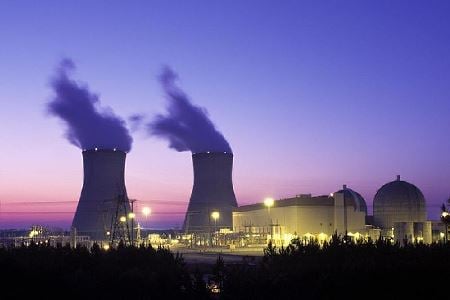 Southern Co. is adding two AP1000s at its Vogtle Station in Georgia. Credit: WikipediaIn August 2017, Duke Energy Florida told state regulators that it would scrap plans to build the Levy Nuclear Project, which would have used AP1000 reactors. Days earlier, Duke Energy Carolinas said it would no longer pursue two AP1000s at the existing Lee Nuclear Station.
"Risks and uncertainties to initiating construction on the Lee Nuclear project have become too great and cancellation of the project is the best option for customers," a Duke Energy statement said.
In early January, Brookfield Business Partners, together with institutional partners, agreed to buy all of Westinghouse from Toshiba for about $4.6 billion.
Natural Gas
A second challenge likely to be addressed by the utility is the rise of natural gas as a reliable and low-cost fuel for power generation.
(Read "Insight: Natural Gas and the Fall of Coal--and Nuclear.")
Both the relatively stable price of natural gas and its widespread availability have been enhanced through technological advances in hydraulic fracturing and directional drilling.
Two decades ago, price volatility and uncertain supplies made it impossible for electric utilities to specify natural gas-fired generation as a long-term investment option. 15 years ago it seemed certain that the U.S. would have to import natural gas.
All that changed with the widespread adoption of hydraulic fracturing (fracking) technology, which opened natural gas fields that previously were uneconomic to develop. What's more, directional drilling has enabled multiple wells to be drilled from a single pad site. Doing so reduces costs and boosts efficiency.
 At the same time, new pipeline construction has made it possible for natural gas produced in the Marcellus field of Pennsylvania and Ohio to reverse the historic flow of natural gas by sending gas from the north to the south.
These factors have been emerging over a period of years but gained traction between 2010-2012 and have persisted. One casualty has been nuclear power generation. A number of nuclear power plants in the northeast and midwest U.S. have been forced to shut down because they are uneconomical to run.
In late March, for example, FirstEnergy Solutions and FirstEnergy Nuclear Operating Co. made a voluntary filing under Chapter 11 of the United States Bankruptcy Code. The company asked U.S. Secretary of Energy Rick Perry for an emergency order directing grid operator PJM to secure long-term capacity from FES plants, including its nukes. As of this writing, Perry reportedly was considering the request for an emergency order.